Emergency Lighting Principles: Safety and Security on the Path of Egress
Sept 16, 2019
By Kevin Smee, Vice President Sales at AimLite
Most of us take light for granted. It has become so ubiquitous and cheap to use that we don’t really stop to think about emergencies. Thankfully most buildings are required by law since 1974 to be equipped with emergency lighting that automatically activates during power failures to facilitate our exit.
Emergency lighting is only one component of a building’s life safety systems, but perhaps one of the most important. It provides a minimum level of visibility to help direct the building’s occupants safely out of it. Moreover, it also helps personnel and emergency responders locate safety equipment, perform safety functions, or shut down hazardous equipment or operations.
Requirements for emergency lighting differ from facility to facility, but we will attempt to shed some light on the subject so you can better be acquainted with the emergency lighting category.
About emergency lighting
An emergency light is, in its most simple definition, a battery-backed lighting device that switches on automatically when a building experiences a power outage or when a lighting circuit fails.
Emergency lighting is mandated by federal, provincial and/or association codes and criteria. These are borne out of those collective governing bodies’ desire to achieve safety and security on the path of egress, in residential, commercial and industrial areas.
Path of egress refers to a continuous and unobstructed way to exit a building, structure or space. Buildings or portions of buildings thereof must, in accordance with various safety codes, have a sufficient amount of lighting on paths of egress. These must be maintained and well lit in the random event of an emergency. The lighting used in these emergency exit paths must also fit certain codes.
Emergency lighting other than emergency signs must provide an average level of illumination of 10 lx or 1 foot candle and cannot be less than 1 lx or .1 foot candles (luminous flux per unit area) at floor or tread level in places such as exit ways, principal exit routes, corridors serving the public, underground walkways, and more.
How does emergency lighting work?
When power is lost, AC power is therefore lost, so the backup battery unit turns on and transfers power to the lighting system (this is called DC power). When AC power is restored, the emergency lighting batteries must be fully charged within 24 hours.
The National Fire Code of Canada (FCC) requires that emergency lighting be tested for one minute each month and once a year a full discharge for 30 minutes (repeated 24 hours later)
The reason is simple, cyclic operation is required for all batteries; otherwise it will probably not work when the time comes. It’s proven that non cycled batteries have a lifespan of no more than 3 years, whereas regularly cycled batteries have a minimum lifespan of 7 years. Most battery units can comprise an auto-test function to facilitate meeting code requirement. The 30-minute discharge test is intended to simulate an emergency situation in accordance with FCC requirements. The second 30-minute discharge test performed 24 hours later aims to ensure that the product is ready in case of power failure CSA requires all emergency power supplies to be fully charged in less than 24 hours.
About exit signs
An exit sign is a device used in any public facility and denotes the location of the closest emergency exit in case of a fire or other emergency. It has to be powered, show the exit direct, and can be mounted in various ways depending on preferences or location (ceiling mounting, recessed mounting, end mounting, wall mounting or pendant mounting).
There are different types of emergency exit signs, depending on environment and application.
Electrical signs include:
• Running Man
• Exit
• Exit-Sortie
• Sortie
Non-electrical signs include:
• photo-luminescent signs
• tritium (radio luminescent) signs
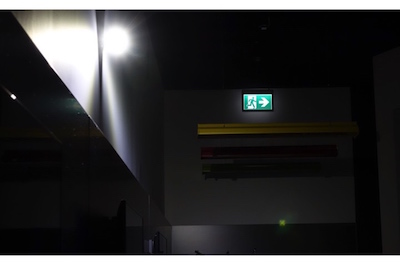
Currently, new constructions are required by code to install the new green running man signs, consisting of a green and white pictogram and arrow, which display the direction of the exit. Older constructions are required to gradually update the old red exit text signs to the running man ones, to conform to the 2015 National Building Code.
Every exit sign must be visible from a distance of 100 feet and on approach of the exit. It can be internally or externally illuminated, in conformance with their respective codes. Internally illuminated signs are powered by an electrical circuit. Externally illuminated signs are not powered by an electrical circuit, but by regular luminaires and must maintain 5’ candle per legend 24/7.
The breaker serving emergency signs cannot light anything else but the sign it was wired for. It must also be connected to an emergency power supply at all times and remain on even when there is no AC power failure. In short signs must be on a dedicated breaker.
AC/DC
No, we’re not referring to the 80s band! AC/DC refers to the current that powers the emergency light.
The abbreviations are defined as follows:
• AC = alternating current (hydro)
• DC = direct current (batteries)
Alternating current (AC) is an electric current that periodically reverses direction, in contrast to direct current (DC) which flows only in one direction. Alternating current is the form in which electric power is delivered to businesses and residences, and it is the form of electrical energy that consumers typically use when they plug kitchen appliances, televisions, fans and electric lamps into a wall socket.
Direct current (DC) is constantly self-powered, such as with a battery, so that the current (voltage) is always constant, with no dips or spikes.
Normally on/off
• “Normally on” means the unit is on all the time, 24/7. It is active when AC power is present or when DC power kicks in. Exit signs are always “normally on”.
• “Normally off” means the unit is off when AC power is running, but turns on when DC power kicks in. Remote heads are usually “normally off”.
Types of emergency lighting
Traditional: battery units utilizing sealed lead batteries in various configurations to give 6vdc, 12vdc or 24vdc output to normally off remote heads when AC power is lost to the panel they are connected to.
Battery packs will operate to a maximum of 120 minutes to the minimum required by code of 30 minutes.
Inverters: there are two types:
• IPS interruptible power supply… in short standby system non instant transfer
• UPS Inverters uninterruptible power supply… in short no break load. Maintains 1 cycle of load 24/7 unnoticeable transfer
Both types work off of batteries IPS (mini inverters up to 1440w), utilize a 12vdc or 24vdc battery source, and convert to 120vac for a minimum of 30 minutes with one single circuit allowing regular luminaires to be lit 100% normally on and during a power failure.
UPS Inverters work utilizing 10 12vdc batteries in series to handle normally on loads up to 55kw in single phase or 3 phase applications (loads may vary pending on which phase using).
Inverters are a continuous AC supply and are a single point of service for large commercial, industrial and institutional projects.
To learn more about our inverters, check our Inverters Brochure.
Generators: no batteries required but a backup of diesel or propane tanks are needed to fuel this standby system, which will back up critical lighting and signage in case of a power outage.
The transfer time varies on these 120v or 347v systems but normally is 10-16 seconds pending on loads and age of systems.
These systems are generally used in large condos and industrial jobs.
In conclusion
As we’ve seen, there are many things that make the emergency lighting category particular. We looked at emergency light principles and codes, how it functions, the exit signs subcategory (including electrical and non-electrical signs), and what AC/DC and normally on/off mean. We hope we were able to enlighten you on the subject and that it will help you on your next emergency lighting project.
Kevin Smee, Vice President Sales, AimLite Canada
![Guide to the Canadian Electrical Code, Part 1[i], 26th Edition– A Road Map: Section 76 — Temporary Wiring](https://electricalindustry.ca/wp-content/uploads/2026/05/EIN-Stock-Guide-Code-Canada-Map-1200-768x403.png)