Canada to Require 100% of Car and Passenger Truck Sales be Zero-Emission by 2035 in Canada
July 8, 2021
To build a cleaner, more prosperous economy that fights climate change and creates good jobs, the Government of Canada is taking action to cut pollution from all sectors of the economy – including from the transportation sector, which accounts for one-quarter of our greenhouse gas emissions.
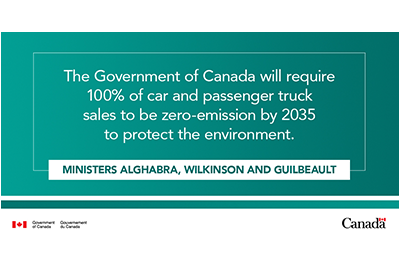
Today, the Minister of Transport, the Honourable Omar Alghabra, the Minister of Environment and Climate Change, the Honourable Jonathan Wilkinson, and the Minister of Canadian Heritage, the Honourable Steven Guilbeault, announced that the Government of Canada is setting a mandatory target for all new light-duty cars and passenger trucks sales to be zero-emission by 2035, accelerating Canada’s previous goal of 100 percent sales by 2040.
To ensure Canada gets to this goal, and to provide certainty about the pathway to get there, the Government of Canada will pursue a combination of investments and regulations to help Canadians and industry transition to achieve 100 percent zero-emission vehicle sales by 2035. It will work also with partners to develop interim 2025 and 2030 targets, and additional mandatory measures that may be needed beyond Canada’s light-duty vehicle greenhouse gas emissions regulations.
Today’s announcement is coupled with existing measures to support increased zero-emission vehicle adoption – from incentives that help with the upfront costs of zero-emission vehicles, to investments in zero-emission charging infrastructure, to partnerships with auto manufacturers which are helping them re-tool and produce zero-emission vehicles right here in Canada. Taken together, the government is setting the country on a clear path towards Canada’s new 100 percent zero-emission vehicle sales goal and a prosperous net-zero emissions economy by 2050.
The Government of Canada also remains committed to aligning with the most ambitious light-duty vehicle greenhouse gas emission regulations in the United States. Supporting a strong and unified North American automotive sector to transition towards zero-emission vehicles contributes to Canada’s climate change goals, and positions Canadian and American workers alike to benefit economically from this global shift.
Quotes
“Only bold climate policies lead to bold results. Through measures aimed at accelerating the transition to 100 percent zero-emission vehicles sales, we will continue building a cleaner and more resilient economy, while also creating good jobs and opportunities for all Canadians. We will also continue to support the automotive sector, including through our investment of $8 billion to accelerate the industrial transition thanks to the Net Zero Accelerator.”
The Honourable Omar Alghabra
Minister of Transport
“Cutting our transportation emissions is one of the most readily achievable and economically beneficial paths Canada can take on the road to net-zero emissions by 2050. That’s why we are committed to aligning Canada’s zero-emission vehicles sales targets with those of the most ambitious North American jurisdictions. We will work with the United States to harmonize performance-based greenhouse gas regulations and greenhouse gas emission standards. We’re investing in consumer rebates, charging stations, business tax breaks and industry transition costs to make the shift to zero-emission vehicles as seamless as possible for drivers, workers and entrepreneurs.”
The Honourable Jonathan Wilkinson
Minister of Environment and Climate Change
“Today, we take another important step on the road to net zero by accelerating our zero-emission vehicle targets to 2035. Achieving this target will require all Canadians, and businesses big and small, to embrace the change and go electric. That is why we will continue to invest in measures that put Canadians in the driver’s seat to a net zero future.”
The Honourable Seamus O’Regan Jr.
Minister of Natural Resources Canada
“Transportation accounts for one-quarter of Canada’s emissions. The Advisory Council on Climate Action, which I co-chaired, made the uptake of zero emission vehicles across Canada a key element of its recommendations in 2019. By increasing our ambitions on zero-emission vehicles, and by taking the measures needed to achieve them, we’re joining an increasing number of other jurisdictions, including Quebec, which have set 100 percent zero-emission vehicle sales targets. This important additional step today will help meet our goal of net zero emissions by 2050.”
The Honourable Steven Guilbeault
Minister of Canadian Heritage
“This initiative is another great example on the way in which the Government of Canada leads by example when it comes to building a climate-resilient economy. Public Services and Procurement Canada is proud to advance the procurement and installation of Electric Vehicle Charging Stations infrastructure at federal buildings and we will continue to support the conversion of our government’s fleets to zero-emission vehicles.”
The Honourable Anita Anand
Minister of Public Services and Procurement
Quick facts
Canada’s accelerated zero-emission vehicle sales target will support the new 2030 climate reduction targets, which are 40 percent to 45 percent below 2005 levels. With light-duty vehicles remaining in service for about 15 years, requiring 100 percent of vehicles to be zero-emission by 2035 will also help put Canada on a path to achieving its long-term goal of net zero emissions by 2050.
Today’s announcement will bring the Government of Canada’s level of ambition on zero-emission vehicles in line with other leading jurisdictions, such as the United Kingdom, and California. Within Canada, British Columbia and Quebec have also set 100 percent zero-emission vehicle sales requirements.
Following the United States announcement, the Government of Canada will complete consultations with Indigenous Peoples, other levels of government and stakeholders to confirm Canada’s approach to ensure we meet 100 percent zero-emission vehicle sales target by 2035.
The Government of Canada will assess whether alignment with these regulations enables Canada to meet its more ambitious zero-emission vehicles sales target, or whether additional mandatory measures are required.
Building on ongoing stakeholder engagement on zero-emission vehicles held to date, the Government will consult industry, non-governmental organizations, and other levels of governments on its approach to meet its 100 percent zero-emission vehicle sales target by 2035. These consultations will include engaging Inuit and Northern communities to address barriers to zero-emission vehicle uptake in remote regions.
To date, the Government has invested more than $1 billion in measures to support increasing zero-emission vehicle adoption, including:
Providing $587 million towards Transport Canada’s Incentives for Zero-Emission Vehicles program, which has helped over 92,000 Canadians and Canadian businesses make the switch to zero-emission vehicles; and
Providing more than $460 million to support the build out of a coast-to-coast network of electric vehicle fast chargers, electric vehicle chargers where Canadians live, work and play, natural gas stations along key freight corridors, and hydrogen stations in metropolitan centres. To date these investments have supported projects that will result in more than 16,500 new electric vehicle chargers, 10 hydrogen stations, and 20 natural gas stations.
The auto industry is investing hundreds of billions of dollars to accelerate their vehicle electrification plans, including recent commitments to re-tool several Canadian factories to build zero-emission vehicles.
The Government of Canada has also introduced new measures to support Canada’s automotive sector transition to zero-emission vehicles, including a 50 percent corporate tax cut for businesses manufacturing zero-emission vehicles and components in Canada.
The $8 billion Strategic Innovation Fund – Net Zero Accelerator is advancing projects that will help decarbonize heavy industry, support clean technologies and help meaningfully accelerate domestic greenhouse gas emissions reductions by 2030, including in the auto-manufacturing sector.
The Government of Canada is making investments to support the transformation towards electrification, including $295 million to the Ford Motor Company of Canada’s $1.8 billion project to build electric vehicles at its Oakville Assembly Complex.
As the common service provider for the Government of Canada, Public Services and Procurement Canada (PSPC) leads and enables greening government operations, and will lead the procurement of electrical fleet vehicles as well as the procurement and installation of Electric Vehicle Charging Stations infrastructure in federal buildings.
PSPC will run a pathfinder project over the coming years to support the greater deployment of zero-emission vehicles infrastructure, with the installation of chargers in crown-owned (and lease purchase) buildings with floor areas greater than 500 m2, which is required to meet the Government’s greening government zero-emission vehicles targets. The procurement and installation of zero-emission vehicles infrastructure at crown-owned federal buildings’ parking areas will prioritize the charging of the federal fleet, and make the overflow available to visitors seeking services from provided service counters to charge their personal vehicles.
Clean Energy Canada found that with measures in Canada’s A Healthy Environment and a Healthy Economy plan, jobs in the EV industry are expected to increase twenty-six fold by the end of this decade.
As the sale and production of zero emission personal vehicles increases, upfront prices will fall. Bloomberg New Energy Finance and the International Council on Clean Transportation predict zero-emission vehicles will reach price-parity with their gas-powered counterparts in the 2025-2030 timeframe.






![Guide to the Canadian Electrical Code, Part 1[i], 26th Edition– A Road Map: Section 76 — Temporary Wiring](https://electricalindustry.ca/wp-content/uploads/2026/05/EIN-Stock-Guide-Code-Canada-Map-1200.png)