National Building Construction Prices Rise 7.5% in Second Quarter 2021
EIN Construction index 400

August 12, 2021

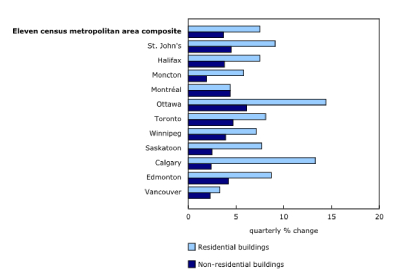
Residential building construction prices rose 7.5% in the second quarter, the largest increase since the series began in 2017, accelerating from a 4.9% increase in the first quarter. Non-residential building construction prices (+3.7%) grew at their fastest pace since the second quarter of 2008.

Construction costs continue to rise in the second quarter

Construction costs for single-detached houses and apartment buildings contributed the most to the residential building construction price growth in the second quarter. The price increase for non-residential construction was mostly attributable to office buildings, warehouses and shopping centres.

Higher residential building construction prices in the second quarter were largely due to record high lumber and wood product prices. Prices for lumber and other wood products increased by 27.9% from the first to the second quarter of 2021. This price surge was due to ongoing supply chain constraints, combined with high demand for new houses and renovations in the wake of changing preferences for more space during the pandemic, as well as low interest rates. The supply chain constraints included ongoing operational delays at sawmills, as well as transportation difficulties.

Additional demand from across the border—reflected by higher values of exports of forestry products and building and packaging materials (+8.9%) in May—further added to building material shortages domestically.

Pandemic-related demand puts upward pressure on construction prices

In the second quarter, residential building construction prices rose in every census metropolitan area (CMA) covered by the survey, mainly driven by higher costs to build single-detached houses in Toronto, Calgary and Ottawa.

Higher prices for single-detached houses were partly related to the demand for more living space during the lockdowns for a home office or remote learning, and because of the increased need for lumber in building a single-detached house, relative to a multi-family dwelling.

Non-residential building construction price increases were driven by higher construction costs in Toronto, Vancouver and Montréal.

Demand for warehouse space continued to climb with retail e-commerce sales increasing by 4.8% from February to May. This increased demand, combined with supply shortages, particularly of concrete and structural steel, raised costs for non-residential construction in the second quarter.

Record year-over-year construction price growth led by Calgary, Ottawa and Toronto

Nationally, residential construction building prices increased 18.8% year over year in the second quarter—the largest increase since the data series began in 2017—led by higher construction costs for single-detached houses (+23.9%). Construction costs for residential buildings rose at the fastest pace in Calgary (+31.4%), Ottawa (+28.4%), as well as in Toronto and Edmonton (both up 22.4%) in the second quarter.

Non-residential construction building prices rose 5.7% year over year—the largest increase since the fourth quarter of 2008, led by Ottawa (+10.1%), Montréal (+8.4%) and Toronto (+7.7%).

Go HERE for more information

Related Articles


Latest Articles

  • Guide to the Canadian Electrical Code, Part 1[i], 26th Edition– A Road Map: Section 56

    Guide to the Canadian Electrical Code, Part 1[i], 26th Edition– A Road Map: Section 56

    February 6, 2026 By William (Bill) Burr The Code is a comprehensive document. Sometimes it can seem quite daunting to quickly find the information you need. This series of articles provides a guide to help users find their way through this critical document. This is not intended to replace the notes in Appendix B or Read More…

  • 3D Printing: Inside Lighting’s Next Revolution

    February 5, 2026 While 3D printing in mass production was once a dream, advancements in the technology have moved it more into the mainstream. The technique, which is also referred to as additive manufacturing, has rapidly evolved from a niche prototyping tool into a transformative production method for many sectors, including the lighting industry. As Read More…

  • Microgrids & Power Quality: Designing Resilient, Clean Facility Power

    Microgrids & Power Quality: Designing Resilient, Clean Facility Power

    February 5, 2026 In an era of extreme weather, aging infrastructure, and ever‑rising energy demands, many facility managers are rethinking their relationship with the grid. Microgrids offer a way to take control and operate autonomously when necessary. A microgrid is more than just backup, when designed properly, it becomes a platform for resiliency, efficiency, and Read More…

  • ITC 101: Understanding NEMA Ratings for Electrical Enclosures

    ITC 101: Understanding NEMA Ratings for Electrical Enclosures

    February 5, 2026 Understanding NEMA Ratings for Electrical Enclosures NEMA Ratings are an essential classification system used across North America to define the environmental and mechanical protection provided by electrical enclosures. Developed by the National Electrical Manufacturers Association (NEMA), these ratings help engineers, installers, and specifiers identify the appropriate enclosure type for industrial, commercial, and outdoor Read More…


Changing Scene

  • Lighting What’s Next: Stanpro Celebrates 65 Years

    Lighting What’s Next: Stanpro Celebrates 65 Years

    February 6, 2026 “We didn’t get here by standing still. For 65 years, we’ve shaped how we think, how we design, and what responsibility means,” the company said in a LinkedIn post. “Today, that thinking takes a new form. Not to change who we are, but to express our evolution more clearly. This is Stanpro, Read More…

  • Housing Priorities on Track in New Brunswick, but More Work to do: Hickey

    Housing Priorities on Track in New Brunswick, but More Work to do: Hickey

    February 6, 2026 Efforts to support the creation of new affordable housing and reduce chronic homelessness are on track, but there is still lots of work to do, according to David Hickey, the minister responsible for the New Brunswick Housing Corporation. New data indicates progress has been made on three key government priorities related to Read More…

  • BJ Electric is now Bernie’s Electric Supplies Ltd

    BJ Electric is now Bernie’s Electric Supplies Ltd

    February 6, 2026 BJ Electric had been teasing a major announcement on their social media recently, before finally announcing last week they have rebranded as Bernie’s Electric Supplies Ltd, a nod to the company’s founder and legacy. “BJ Electric Supplies is now Bernie’s Electric Supplies—in honor of our founder, Bernard Joseph Thompson, and the values Read More…

  • The Government of Canada Introduces the Build Canada Homes Act

    The Government of Canada Introduces the Build Canada Homes Act

    February 6, 2026 The Government of Canada has introduced the Build Canada Homes Act, legislation that will establish Build Canada Homes as a Crown corporation whose mandate will be dedicated to building affordable housing in communities across the country. As Canada’s affordable housing builder, this legislation will equip Build Canada Homes with the necessary tools to Read More…