Considerations for Selecting the Right Multimeter
October 2, 2023
Article By Fluke
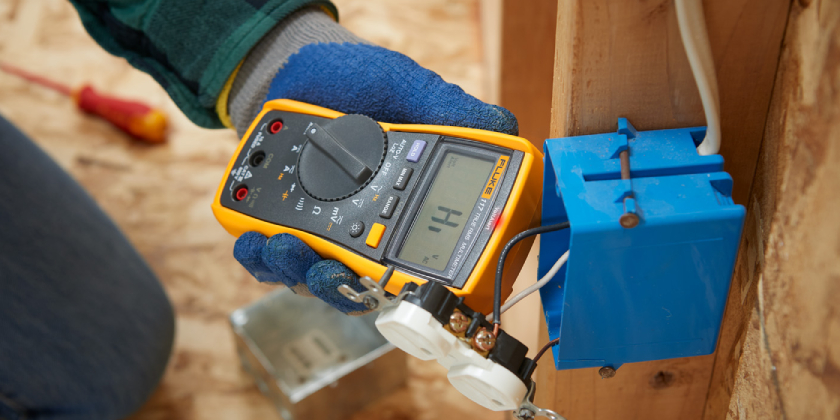
Many individuals venturing into the world of electronics often ask, “How does one select the right multimeter when starting out in the trade?” To aid in this quest, it’s essential to consider certain primary features a multimeter should offer.
Voltage – Can it measure both AC and DC voltage?
Technicians typically embark on troubleshooting tasks with an understanding of a circuit’s standard performance. Circuits deliver energy to a load, which can range from small gadgets to large industrial motors.
These loads often come with a nameplate detailing standard electrical values, including voltage and current. In the absence of a nameplate, manufacturers might offer a comprehensive schematic or even manuals that list these values. Such data allows technicians to anticipate regular readings during the load’s normal operation.
If a multimeter produces a reading that deviate from these expectations, it provides a starting point for diagnosing the issue, though the exact cause requires more nuanced analysis based on expertise.
Resistance and Continuity – Can the meter ascertain if a wire is interrupted?
Resistance measurements generally serve as an indicator of a component or a circuit’s health. High resistance correlates with low current flow. This could be due to reasons like conductor damage from burning or corrosion. All conductors emit some heat; thus, resistance often hints at overheating issues.
Conversely, low resistance means high current flow, which might stem from damaged insulators affected by moisture or excessive heat. Components like heating elements and resistors have defined resistance values, often detailed on nameplates or in manuals. If the actual measured resistance significantly deviates from this expected value, it’s a sign of a problem.
Continuity checks if there’s a complete path for current flow. A closed, operational switch has continuity, while an open one does not. A multimeter, during a continuity test, sends a minor current through the circuit, gauging resistance in the process.
Current – Can it measure the current traversing a wire?
Most multimeters can measure AC or DC currents up to 10 amps. For currents exceeding this, you’ll need a current clamp accessory. This accessory will gauge the magnetic field around a conductor, enabling measurements without interrupting the circuit.
Components, whether they’re lamps, motors, or heating elements, convert electrical energy into other forms. The circuit’s load capacity and the size of the conductors, fuses, and components determine the current flow. Measuring this current is integral to troubleshooting.
Other considerations – safety, size, and portability
Safety is paramount. Ensure your multimeter has a safety rating of at least CAT III 600 volts, which is pivotal for on-the-job safety.
Think about how the multimeter’s size and portability will work for you. Their designs can range from compact to hefty and robust. The right choice depends on the task at hand. Some multimeters, like those produced by Fluke, even come with a drop safety rating of one meter. This ensures that the device will remain functional even if it falls, such as from a ladder.
In conclusion, the ideal multimeter balances features, safety specifications, and practicality. Always conduct in-depth research before making a choice.
![Guide to the Canadian Electrical Code, Part 1[i], 26th Edition– A Road Map: Section 74 — Airport installations](https://electricalindustry.ca/wp-content/uploads/2026/05/EIN-Stock-Guide-Code-Canada-Map-1200-768x403.png)




![Guide to the Canadian Electrical Code, Part 1[i], 26th Edition– A Road Map: Section 74 — Airport installations](https://electricalindustry.ca/wp-content/uploads/2026/05/EIN-Stock-Guide-Code-Canada-Map-1200.png)