Canada’s Construction Industry Poised for Growth Amid Policy Shifts and Cost Pressures

February 2, 2026
Latest economic data highlights positive growth indicators for Canada’s construction industry, outpacing other Canadian industries, despite an ongoing rise in construction costs and supply chain disruptions.
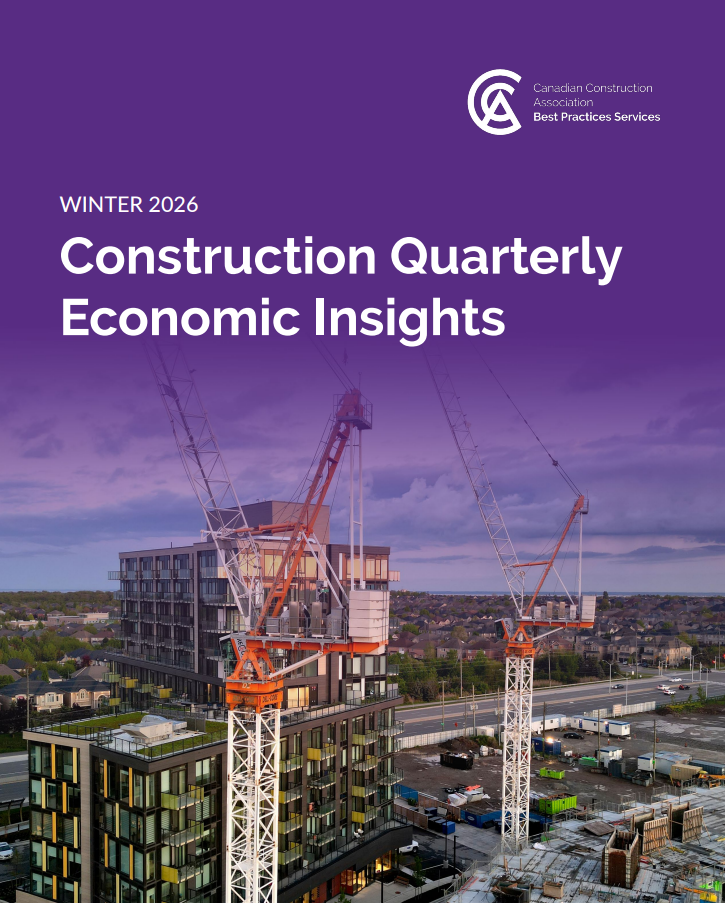
The Canadian Construction Association (CCA) released its winter edition of its Construction Quarterly Economic Insights (CQEI) report, showing a growth in construction GDP output of 1.3 per cent in Q3 2025, successfully outpacing the all-industry average and setting the stage for continued advancement.
“The opportunities ahead for our industry are significant, but so are the risks,” said Rodrigue Gilbert, CCA’s President. “Investments from the federal government will drive growth, but rising costs and workforce constraints will continue to limit the industry’s ability to unlock its full potential and deliver on Canada’s ambitious construction agenda.”
Facing the end of 2025, the Building Construction Price Index (BCPI) increased 4.2 per cent year-over-year in Q3, with increases particularly driven by metal fabrications, structural steel, and plumbing. Canadian jurisdictions most affected by cost increases were noted as London, (ON) and Quebec City (QC). Additionally, the cost of factory construction increased by 5.7 per cent, while the cost of office building increased by 3.2 per cent.
The 2025 federal budget, published in November 2025, presented $89.7 billion in net new measures over the next five years, with $32.5 billion being classified as capital investments. In total, CCA noted approximately $32 billion in new construction-related spending earmarked over the next five years.
“2025 was a very strong year for our industry and we’re looking forward to building on that progress to build the Canada that Canadians deserve,” said Gilbert. “Together, we’ll keep building Canada.”
Key insights
- Canadian economy steadied: GDP rebounded in the third quarter of 2025, growing at an annualized rate of 2.6 per cent, surpassing $2.5 trillion. As the Bank of Canada moves to sidelines, interest rates are expected to remain at 2.25 per cent through much of 2026.
- Building permits lowered further in Q3: Following a downturn in the second quarter, building permits weakened by a further 5.1 per cent to $32.5 billion in Q3, representing a 9.9 per cent year-over year (YOY) decline. Ontario recorded the largest drop, with permit values down 15 per cent quarter-over-quarter. However, early Q4 permit activity suggests a rebound that could make up for the slack in Q2 and Q3, lifting the annual total into positive territory.
- Cost pressures remain elevated: Construction input costs continue to rise, led by steel-intensive divisions. The Building Construction Price Index (BCPI) increased 4.2 per cent YOY. Contractors should plan for ongoing price volatility, especially in factory construction and in higher-inflation regions like London and Quebec City.
- Federal Budget bolsters construction demand: Budget 2025 reinforces long-term construction demand, committing $280 billion over five years in capital investments. New measures introduce $150 billion in net spending before operational savings, with roughly one-fifth tied to construction-related activity. This package is built around three core federal priorities: attracting private investment, prioritizing Buy Canadian procurement, and supporting unionized labour.
The next Construction Quarterly Economic Insights report will be published in April 2026.
![Guide to the Canadian Electrical Code, Part 1[i], 26th Edition– A Road Map: Section 74 — Airport installations](https://electricalindustry.ca/wp-content/uploads/2026/05/EIN-Stock-Guide-Code-Canada-Map-1200-768x403.png)



![Guide to the Canadian Electrical Code, Part 1[i], 26th Edition– A Road Map: Section 74 — Airport installations](https://electricalindustry.ca/wp-content/uploads/2026/05/EIN-Stock-Guide-Code-Canada-Map-1200.png)