BCIT begins $48 million Renewal of Burnaby Campus

February 14, 2025
The British Columbia Institute of Technology (BCIT) is beginning a major revitalization project on the south side of its Burnaby Campus, which will ultimately enrich the applied educational experience for students and further cultivate a thriving work environment for employees. The BCIT South Campus Infrastructure Renewal project (SCIR) provides a unique opportunity to enhance public spaces, improve accessibility, and create a more vibrant and inclusive campus environment. It will also upgrade aging infrastructure to ensure climate resilience and support sustainability efforts.
With a $48 million investment from the Province of British Columbia, this phase of the SCIR project encompasses the first three of five separate zones of the project with construction set to begin in early 2026 and to run until 2029.
“Our government is committed to investing in BC to strengthen and diversify it, and the best way to do that, is by investing in the future workers of the province,” said Anne Kang, Minister of Post-Secondary Education and Future Skills. “The infrastructure upgrades at BCIT today will create a cutting-edge environment to be the foundation for training and education and foster growth, opportunity, and bigger paychecks for all.”
“It’s great to see schools like BCIT growing and adapting to meet the diverse needs of their students,” said Bowinn Ma, Minister of Infrastructure. “The updates to the South Campus will enhance the student experience while also providing more staff and visitors with an enriched environment, reflecting our government’s commitment to creating sustainable, inclusive, and resilient communities that foster growth and opportunity for all.”
An initiative that puts people and sustainability at the forefront
The project involves significant upgrades to critical underground infrastructure in the South Campus area, including electrical, gas, water, sanitary services, and stormwater systems south of Goard Way. These upgrades will enhance climate resilience and prepare the campus for future developments.
“The South Campus Infrastructure Renewal Project is vital to BCIT’s future – creating a sustainable, interconnected community that enhances education, supports staff and faculty, and fosters industry collaboration,” said Dr. Jeff Zabudsky, BCIT President. “We thank the Province of British Columbia for investing in this transformative initiative that enables BCIT to continue to deliver on its vision of empowering people, shaping BC, and inspiring global progress.”
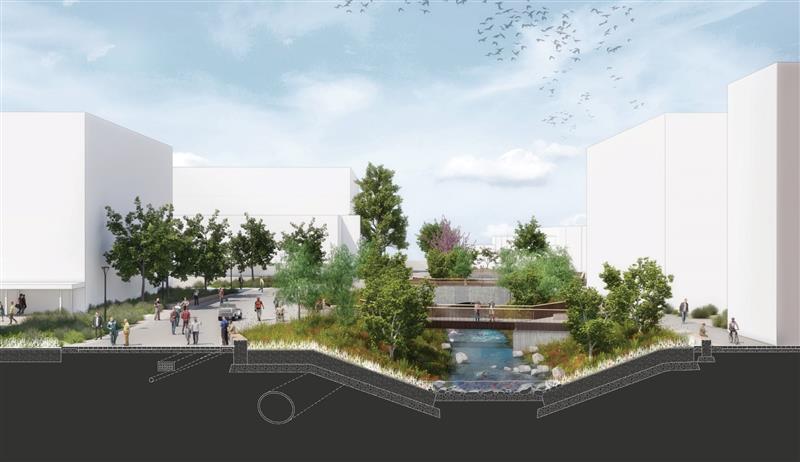
Above ground, the campus will see more open spaces, a restored urban greenway, a campus walkway connecting the new Tall Timber Student Housing building to the core of campus, and upgraded wayfinding, bicycle networks, and accessibility throughout public areas. Additionally, the project will support the continued daylighting of Guichon Creek – creating a natural ecological habitat suitable for salmon.
Notably, this project also marks the retirement of the Energy OASIS site. This highly successful project built by BCIT’s Smart Microgrid Applied Research Team (SMART) includes a large solar panel canopy, control systems, and EV charging. Over its lifespan, OASIS successfully demonstrated how large-scale microgrids can complement and connect to utility networks as well provide resilience when the grid power is not available. The SMART team continues to leverage the learnings of OASIS and looks forward to sharing updates on future projects soon.
Throughout the revitalization period, the SCIR will function as a Living Lab for students, faculty, researchers, and industry partners. Students, particularly those in Civil Engineering, Ecological Restoration, and Construction Management, will gain hands-on experience through collaboration with industry professionals involved with the project.






![Guide to the Canadian Electrical Code, Part 1[i], 26th Edition– A Road Map: Section 76 — Temporary Wiring](https://electricalindustry.ca/wp-content/uploads/2026/05/EIN-Stock-Guide-Code-Canada-Map-1200.png)