Q&A with Keerthana Srinivasan, National Winner of Samsung’s Solve for Tomorrow Contest: Finding Faults for Photovoltaic Farms with SARAH
September 15, 2025
By Blake Marchand
Earlier this year, Samsung announced the winners of its annual Solve for Tomorrow competition for students in grades 6-12. The competition challenges students to come up with solutions for real-world problems in the field of STEM.
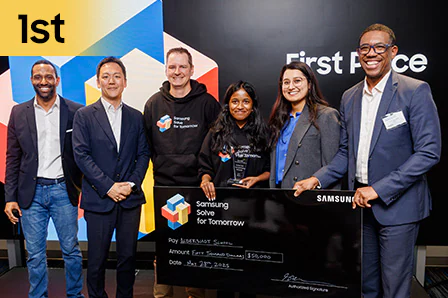
This year’s winner was Keerthana Srinivasan from Aldershot School, who developed System Analysis and Reporting for Advanced Hardware (SARAH) to detect faults for photovoltaic farms.
Initially, Keerthana developed SARAH to help prevent lunar dust abrasion on spacesuits, before turning her focus terrestrial and exploring how her algorithm could be used in solar farms.
The second-place Solve for Tomorrow finalist was STEM Innovation Highschool, which developed a wheelchair and software for headband control of wheelchair movement. The third-place finalist was Elsie MacGill Secondary School, which focused on kinetic plates to turn kinetic energy into electrical energy.
“Aldershot School’s project perfectly embodies the spirit of our Solve for Tomorrow initiative. We challenge young Canadians to apply STEM skills to solve tangible, real-world issues, and they have delivered a solution with direct relevance to the community,” commented Tafari Jilany, Head of Corporate Marketing, Samsung Canada. “It’s this kind of ingenuity and practical problem-solving that proves the next generation is ready to lead, and we are incredibly proud to provide a platform that helps bring their innovative ideas to life.”
Below, Keerthana goes into detail about her experience developing SARAH, how the technology can be implemented, and the next steps for the project.
What are some of the takeaways from your experience working on the SARAH project?
When I first started developing SARAH, I had limited knowledge of the mathematics required to see the project to completion. The first few months of developing SARAH wasn’t even programming, but simply trying to prove the mathematics behind my solution. While this part was quite challenging, I found it very rewarding because I got to learn so much abstract mathematics I’ve never been introduced to before.
The main challenges with SARAH came from the mathematical proof aspect. I was determined to first prove SARAH would work in every instance before programming the idea. This makes SARAH more reliable to legacy companies, as it becomes less ambiguous than previously introduced solutions (e.g, AI, ML).
Developing the mathematical proof was split into three separate proofs: the bifurcation (for detecting if a fault is present), the Extended Kalman Filter (for classifying it), and the Quantum Markov Chain Monte-Carlo (for localizing the fault). Proving the EKF would classify faults was difficult, because it required the manipulation of the equations to prove two things: a) the EKF would have a different residual variance for different fault types and b) the residual variance would remain the same for numbers in the neighbourhood of the same fault type. This required a very deep understanding of EKFs, which took a few months to wrap my head around!
The QMCMC carried a similar challenge, in the sense where there wasn’t a formal proof online to demonstrate QMCMCs specifically. However, there were a lot of proofs for MCMCs, so I studied these proofs a lot before developing my own for the QMCMC.
Once I was able to prove each aspect of the algorithm, programming the algorithm was relatively easier, as I carried a more in-depth understanding of what I wanted to do.
I think my biggest takeaway from this project is how it’s important not to rush. Often with these types of projects, many are pressured to complete things in a certain timeframe. I find that by building SARAH at my own pace, I was really able to gain a deeper appreciation for what I was doing by both talking to experts/stakeholders and immersing myself in so many new things.
What led you to focus on detecting faults in solar arrays?
Before SARAH, I was working on another project called Coulomb–a flexible electrodynamic dust shielding electrode for spacesuit textiles. The goal of Coulomb is to prevent lunar dust abrasion on spacesuits, which can cause severe health and safety hazards to astronauts on the Moon.
After developing the electrode for Coulomb, I realized I have a strong inclination towards chemistry and materials science. This led me to take courses in material informatics, which is a field at the intersection of artificial intelligence (AI) and materials science.
After a few months of learning materials science, I started looking for projects where I could apply my knowledge. My first iteration of SARAH was actually a material informatics algorithm to generate customizable rad-hard coatings for satellite electronics. For two years, I immersed myself in spacecraft electrical power subsystems, learning about modern methodologies for handling these systems and gaps in the industry. In short, what started out as a passion for a technology or science led to an interest in the problem itself.
When I finished developing SARAH in a space-context, I thought about how SARAH could be used on Earth, which led me to solar farms!
What would the integration look like for a solar farm to implement SARAH to detect faults?
Currently, SARAH is able to localize faults with an 85% accuracy on a 200 node system, which is equivalent to a utility-scale solar farm. My vision for SARAH is that it will eventually operate with an accuracy of ~90% on a scale of 100-200 nodes, where every node is an inverter.
The bifurcation aspect–the very first aspect–of SARAH only requires current and voltage as inputs. Current and voltage sensors come standard on many inverters, along with communication protocols (e.g., Ethernet, LoRaWAN). In most cases, we should be able to query the voltage and current from each of the inverters through SARAH, which is an interface that can be set up during the initial days of use.
After this, SARAH is capable of instantaneous fault detection upon request by querying voltage and current values from each of the inverters, and running them through the bifurcation algorithm. Based on the bifurcation’s output, we can determine whether or not a system is stable, which can then trigger the EKF and QMCMC.
Users can request a fault scan through the SARAH application, which I am currently developing as a desktop application. My previous studies on SARAH show that one can run the bifurcation, EKF, and QMCMC on the average desktop, making SARAH relatively economical.
Are there any next steps for the SARAH project?
On October 3rd, I will be giving a presentation on my findings at the International Astronautical Congress in Sydney, Australia. I also plan to publish my findings for feedback from professionals. While SARAH has shown a lot of promise, I think there is a lot that needs to be done on the hardware-end before we can see SARAH’s implementation on actual solar farms.
Just last week, my photovoltaic emulator was launched into Low Earth Orbit, where I will be testing how SARAH operates for solar systems in extreme environments, where there is a lot of noisy data. Based on these results, I will determine if I need to spend more time developing SARAH’s backend, or moving towards commercializing the technology.
![Guide to the Canadian Electrical Code, Part 1[i], 26th Edition– A Road Map: Section 74 — Airport installations](https://electricalindustry.ca/wp-content/uploads/2026/05/EIN-Stock-Guide-Code-Canada-Map-1200-768x403.png)

![Guide to the Canadian Electrical Code, Part 1[i], 26th Edition– A Road Map: Section 74 — Airport installations](https://electricalindustry.ca/wp-content/uploads/2026/05/EIN-Stock-Guide-Code-Canada-Map-1200.png)