Overview of Upcoming Changes to Ontario Construction Act – Joint Leadership Conference Panel Discussion

November 4, 2025
The inaugural Joint Leadership Conference hosted this October in Toronto by three Ontario contractor associations, Electrical Contractors Association of Ontario (ECAO), the Mechanical Contractors Association of Ontario (MCAO), and the Construction Labour Relations Association of Ontario (CLRAO), featured some interesting discussions around AI and changes coming to the Ontario Construction Act.
The keynote speaker, Jim Harris discussed the impact AI can have on productivity if we take the time to understand how to use it effectively. Hon. Andrea Khanjin- Minister of Red Tape Reduction, and Hon. Prabmeet Singh Sarkaria- Minister of Transportation spoke at the event, providing a government outlook on the construction industry.
This article focuses on some of the insights from the Joint Leadership Conference’s Construction Law Panel. Dan Leduc – Partner, Soloway Wright LLP, Krista Chaytor – Partner, Construction Practice Group, WeirFoulds LLP, Robert Kennaley – Principal, Kennaley Construction Law unpacked some of the key changes to the Ontario Construction Act and how the prompt payment/adjudication landscape will be impacted.
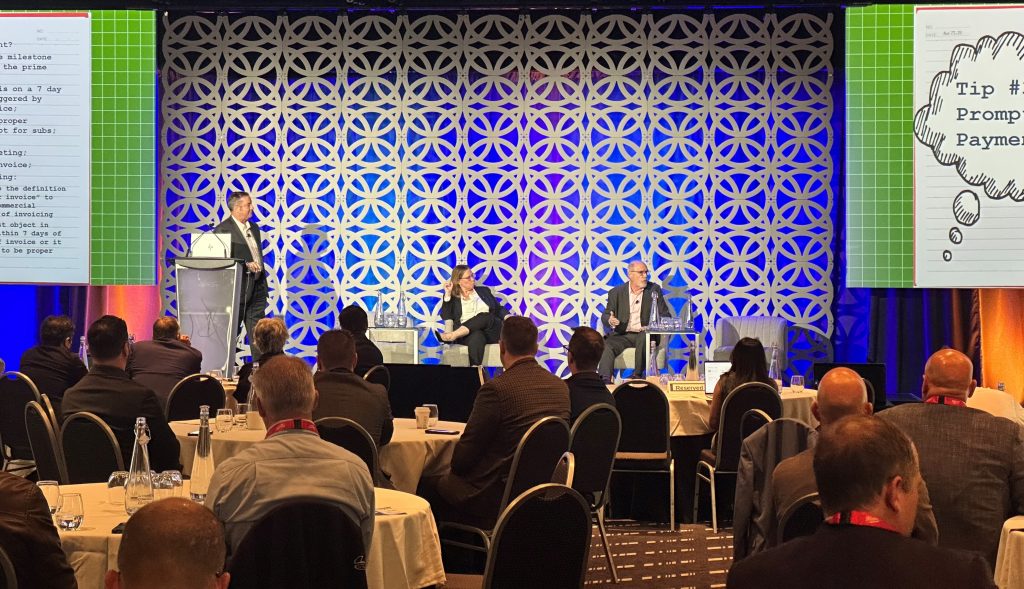
New legislation has been passed in Ontario to amend the Ontario Construction Act as part of the province’s economic strategy. The changes have not yet come into effect, as the legislation still requires proclamation and the final supporting regulation.
The prompt payment system was not working for many contractors, the new legislation aims to keep cash flow on projects moving by patching some inefficiencies in the original regulation.
Key changes:
- Annual release of holdback
- Broadened access to adjudication
- A revised definition/process for “proper invoices”
Annual Release of Holdback
In the Ontario Construction Act, holdback is 10% of the value of services or materials under a contract/subcontract.
Owners will have 14 days from the anniversary of the contract to declare their intention to release the holdback, which is then distributed down to the contractors and subcontractors. The contractor has 14 days to release holdback to its subcontractors, within 14 days of receiving payment.
“You need to be aware that if you have a trade underneath you that is underperformed, that doesn’t finish the job, and you end up having to complete the work for them, that holdback that’s going to come to you in relation to their project – under the new rules, you have to pay them anyway,” explained Kennaley, “because the theory is they’ve already earned it, and then you’ll have to chase them in a courtroom or potentially do adjudication to get that money.”
“The consequences of lien rights arising on an annual basis are and will be significant. You know, when problems arise on a project, most trades and contractors will hold their gunpowder until their lien rights expire before they decide to lien. Now they have to make that call every year. So, the consequence is, almost unavoidably, on projects that get a little stressed, we’re probably going to see a lot of lien claims.”
Notice of Non-Payment
The schedule for being paid is 28 days from Day 0, when the contract was handed to the owner, plus seven days. Once you are paid you have seven days to pay the subcontractor below you. If you haven’t been paid you have seven days to notify the trades below you of non-payment, either from the day you were supposed to be paid or from the day you received a notice of non-payment from the contractor above you.
“If you have any reason to not pay somebody underneath you in a construction contract. You have to stop and think, because you will now be under a statutory obligation to tell those people underneath you that you aren’t going to pay them,” Kennaley said.
“It’s 7 days from the day you should have been paid, or the day you were paid, or the day you got a notice of non-payment from the person above you,” Kennaley said.
“Within that seven-day window, you have to give the person underneath you a notice of non-payment…”
The proposed rules introduce more urgency in the process, which emphasizes the importance of staying on top of paperwork and understanding the contractual timelines of the project.
Day 0 and Invoicing
Under new rules it is important to understand what ‘day 0’ is for the project.
“Day zero is the day that general contractor hands up the proper invoice to the owner,” Leduc noted.
“The first thing you want to do internally is find out what day zero is. Find out what the prime contract says on delivery of that proper invoice. And then you can track the dates that are about to arrive,” he explained.
A key change relating to Day 0 is around invoice rules. The original regulation included some unintuitive requirements relating to the official definition of a proper invoice.
Establishing Day 0 is important because owners can no longer sit on invoices and raise concern later on in the project. Once the invoice is submitted, they have 7 days to say if an invoice is proper and changes can be made. Once the 7 days expire, the invoice is deemed proper. Knowing Day 0 establishes when the 28 day (plus 7 days), to mark when you should be paid/pay subcontractors.
“The definition of proper invoice in the act really seemed to be completely divorced from any business reality. And so, unless you actually had somebody, someone in your office or a lawyer, take your invoice, compare it to these strange requirements in the act, chances are the average invoice of a general contractor was not going to meet the requirements of a proper invoice pursuant to the act,” he explained.
“There were a couple things that kind of made this a strange set of requirements, but the one that always struck me is that the act actually required that your invoice have the name and phone number of an actual human being that you had to direct payment to. And that’s such a strange thing to have on your invoice that no one would have,” Chaytor said.
Proper invoice technicalities would snag a lot of adjudications cases before they could get started.
“The adjudication would never get underway because the very first threshold issue would be this invoice doesn’t meet the requirements, it doesn’t meet the requirements, and therefore adjudication can’t happen,” she explained.
“You can still get stopped in that seven days, but the owner’s going to have to tell you it’s not proper and why it’s not proper, so you can fix it and deliver a proper invoice,” Leduc added.
“The requirements for a proper invoice are going to drop down into your subcontract. So as a trade contractor, you’ve got to be in tune with what the requirements are for the proper invoice and the changes that we’re talking about here today,” he said. “There’s only one proper invoice from the contractor to the owner, but the obligations on you as a trade contractor are going to be there, nonetheless.”
Broader Adjudication Rules
The panel explained that adjudication should now be used as more of a communication tool to motivate the other party. Once adjudication is initiated, it can be paused if the other party comes to the table to discuss the issue.
Adjudication can now take place up to 90 days following the end of the contract, or the point when it was abandoned or suspended to initiate adjudication.
“How often do disputes really crystallize after you’ve finished your contract or subcontract? Most often,” Kennaley said. “Over time, there’s going to be more projects eligible for adjudication, and most of the disputes are going to be eligible for adjudication.”
The panel explained that because of the changes to adjudication rules, there will need to be a mindset shift in terms of tracking the relevant paperwork for a project, because if a dispute arises, the time frames are a lot shorter than they were in the past. They emphasized the importance of field notes and being prepared with quotation paperwork for services/material.
“On a site records basis,” Kennaley said, “you think you’re going to have a back charge for 100-200 feet of cable? You better staple together your backup from the lead letter, or the quotation, or whatever you’ve got for the unit rate for the cable.”
Kennaley noted that field notes are important to provide additional proof of when material/services were delivered and when.
Leduc explained that adjudication should be used as a leverage tool.
“If you’re not paid one, two, three, and we’re in the third payment cycle, we’re not even paid yet,” he said. “I engage in a demand letter/email that has a draft notice of adjudication that says, ‘Hey, we haven’t been paid. You’ve got three days to arrange for payment, or I’m going to trigger this notice of adjudication. That happens a lot in terms of getting paid.
“If I don’t hear from them and I start the notice of adjudication,” Leduc explained, if they engage in discussions, you can stop the adjudication to negotiate.
What is adjudication?
Adjudication is a third party that makes a decision on a dispute largely to a payment issue.
Ontario Dispute Adjudication for Construction Contractors (ODACC) is the company that runs adjudications in Ontario. ODACC is responsible for administering adjudications and for training and certifying adjudicators.
“They’ve got a website, they’ve got a portal, everything you do in your adjudication, you issue your notice of adjudication through the portal, communications are through the portal, decisions delivered through the portal, you upload your documents, it’s all done electronically.”
Change Order
The panel noted that the majority of the adjudications they deal with have to do with change orders. Previously, the scope of adjudication was limited to disputes over payment/non-payment and holdback payment/non-payment. But so often that comes intertwined with work being completed before the change order was officially signed.
“The worst way to trap cash on a project is idle equipment,” Leduc said, “I’m paying for that scissor lift, it’s over in the corner charging and I’m not using it a month after. Second worst way? Change order.”
“You price the work, and benevolently, you know, you go and do the change order before you get the signed change order.”
Under the new rules, Leduc said, “We’re going to use adjudication as a leverage tool. If I need an answer on that change order, I’m going to give them notice that I may go to adjudication. I’ve got these outstanding three change orders I’m not getting a response on… Here’s my draft notes of adjudication.”
You can give them three to four days to respond, if they don’t respond, adjudication can be used as a leverage tool, “to get your answers on those change orders.”
Obligations on the Owner & Cooperation
“With the possible exception of an owner being granted rights of adjudication, there is nothing in the Construction Act that benefits an owner. All the owner gets of that Construction Act are obligations and risks,” Kennaley said, although, he added that owners don’t typically commence claims.
“The Construction Act, through prompt payment and adjudication, is keeping those obligations and risks onto the owner. Now they have to think about a multi-year project, releasing holdback annually, doing that process annually.”
They have 14 days to decide whether or not to pay the proper invoice, and now they have seven days to decide whether or not it is a proper invoice.
The panel stressed the importance of collaboration in the process, to ensure that everyone gets paid.
“I think that trade contractors and contractors need to realize that with this amount of pressure on owners, large institutional owners that have, what, 100 projects on the go at the same time, you have to do everything you can in these things to try to work through the issues that you’re going to be facing.”
“The more cooperation you can get from everybody in the pyramid to help the owner work with the consultant to get them what they need, put them in the position to make that call, the better chance you are to get paid.”