Power Utility in Sarnia-Lambton Fined in Electrocution Death of Worker
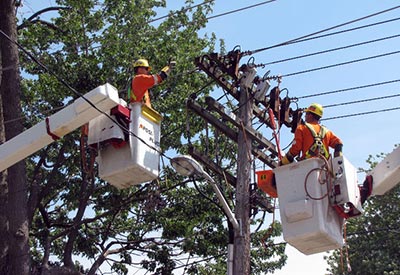
Bluewater Power Distribution Corporation, the utility providing electricity distribution and related services in the Sarnia-Lambton area, has been fined $120,000 in the 2012 death of a worker who was performing repair work following the aftermath of Hurricane Sandy.
The worker was one of two who had been assigned post-storm repair work on Passingham Drive in Sarnia, where trees had downed power lines. On October 31, 2012, the two workers cleared tree limbs and began to repair the electrical lines. One worker was working from an aerial bucket while the other was working from the ground, and they began working on the downed primary neutral line.
Up until that point, the worker in the aerial bucket had been working with leather gauntlet gloves and was preparing to make the final connection by fastening the neutral end to a connector that completes the circuit path. That worker called down to the other to bring rubber gloves from the cab of their truck. While the worker was heading to the truck cab to retrieve the rubber gloves, the truck shook and the boom of the bucket dropped.
The supervisor was immediately called and both ambulance and the fire department were summoned. The worker in the bucket was taken to hospital and could not be revived. Cause of death was determined to be electrocution.
An investigation revealed that no job plan or tailboard was in place prior to the commencement of work. A job plan is typically prepared by a power line technician when the technician arrives at the job site in order to assess the work that needs to be carried out. A tailboard conference – or job site planning meeting – is used to review the job plan, identify hazards and determine how to best mitigate these hazards before work begins.
Job planning and documentation of a tailboard is a requirement under the Electrical Utility Safety (EUSR) Book, Rule 107. These rules have been established as a minimum standard for safety precautions to be followed by employers and workplaces that do not fall under the jurisdiction of Ontario Regulation 851/91 (the Industrial Establishments Regulation) or Ontario Regulation 213/91 (the Construction Projects Regulation).
In this instance, a properlyestablished job plan and tailboard conference would have addressed some of the key hazards and safety failings present at the site. In a statement, the worker who was on site indicated that a job plan was normally completed prior to the project; it was not completed in this instance because they were anxious to bring the power back to the community.
Although both workers had over 20 years of experience each and had been trained on the importance of wearing rubber gloves at all times upon stepping into the aerial bucket on a boom truck, the job plan and tailboard conference would have reiterated the need for using rubber gloves at all times when working on any pole or structure carrying energized conductors. The worker had been wearing leather gloves, which have a reduced electrical resistance compared to rubber gloves. Following the incident, the worker’s gloves were found to contain some dampness, which would have further weakened their resistance to electricity.
The workers should have taken the measure of treating the neutral conductor as energized (“live”) as indicated in Rule 116 of the EUSR Book.
Bluewater Power Distribution Corporation pleaded guilty to failing as an employer to ensure that workers performed a documented job plan before performing work on or in proximity to energized electrical equipment in accordance with Rule 107 of the EUSR.





![Guide to the Canadian Electrical Code, Part 1[i], 26th Edition– A Road Map: Section 76 — Temporary Wiring](https://electricalindustry.ca/wp-content/uploads/2026/05/EIN-Stock-Guide-Code-Canada-Map-1200.png)