Report Assesses Demand Response Strategies and Execution
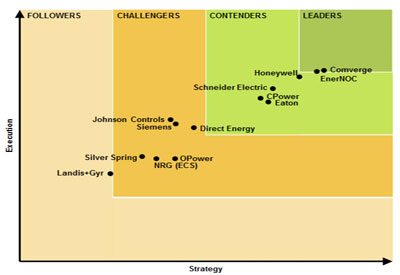
LB DR 15 Chart

Demand response (DR) is becoming a growing part of the resource base that electric system operators depend on to maintain reliability on the grid. A new Navigant Research Leaderboard Report examines the strategy and execution of 13 leading DR providers, and rates the providers against 10 criteria: vision, go-to-market strategy, partners, technology, geographic reach, sales, marketing, and distribution, product performance, product portfolio, pricing, and staying power.

As market liberalization, economic pressures, and environmental regulations all move utilities toward a path of fewer traditional central power plants and more distributed energy resources, DR can help speed this transition and make the grid more reliable along the way. Utilities have run residential direct load control (DLC) programs as forms of demand management and offered interruptible rates to commercial and industrial (C&I) customers for many years. However, today’s consumers expect more help from technology and demand more flexibility in their operations.

DR is starting to experience growth outside of North America, and expansion into other regions is expected to increase in the near future. Numerous countries in Europe are opening up energy markets to DR resources, and as smart meters are rolled out across the continent, the potential for DR improves. In Asia Pacific, countries like Australia, New Zealand, and South Korea have active DR programs. Meanwhile, Japan and China are piloting DR projects and expect to expand DR’s role in their markets in the next few years. According to Navigant Research, the global DR market is expected to grow from $2.0 billion in 2015 to over $12.8 billion by 2023.

Find out more: www.navigantresearch.com/research/navigant-research-leaderboard-report-demand-response.


Related Articles


Latest Articles

  • Capital Constraints in Owner-Operated Trade Businesses – When Owning the Building Quietly Limits Growth 

    Capital Constraints in Owner-Operated Trade Businesses – When Owning the Building Quietly Limits Growth 

    For many contractor-owned businesses, growth starts to feel harder than it should. The work is there. Customers are steady. Crews are busy. Yet when owners look to expand, invest, or create breathing room, capital often feels tighter than expected. In many cases, the issue is not operations or demand. It is a real estate decision made years… Read More…

  • What 2025 Revealed About Canada’s Electrical Industry

    What 2025 Revealed About Canada’s Electrical Industry

    December 16, 2025 By Carol McGlogan, President & CEO, Electro-Federation Canada The past year required Canada’s electrical industry to adapt to a rapidly changing environment. In 2025, businesses across the value chain navigated shifting trade conditions, evolving policy landscapes, and growing expectations tied to electrification and infrastructure expansion. Trade uncertainty introduced new complexity. Organizations reassessed Read More…

  • Considerations for EV Charging Installation and Site Preparation

    Considerations for EV Charging Installation and Site Preparation

    December 15, 2025 By Blake Marchand As part of our recent discussion with LEDVANCE EVSE Product Manager, Erich Bockley, he emphasized the importance of site preparation Site preparation can be the most complicated part of the project, Bockley emphasized, a lot needs to be considered before the installation work begins. Many public charging applications will Read More…

  • Ontario’s Multi-Family Component Leads Residential Sector Increases in October Building Permits

    Ontario’s Multi-Family Component Leads Residential Sector Increases in October Building Permits

    December 15, 2025 In October, the total value of building permits issued in Canada rose $1.8 billion (+14.9%) to $13.8 billion. The increase in construction intentions was led by the residential sector (+$1.1 billion). An increase was also observed in the non-residential sector (+$702.8 million). On a constant dollar basis (2023=100), the total value of building permits issued in Read More…


Changing Scene