Building Permits Up 14.8% in June
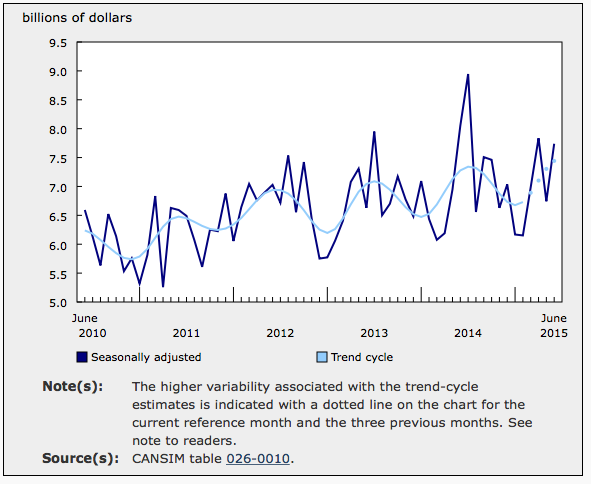
The total value of building permits rose 14.8% to $7.7 billion in June, following a 13.9% decrease in May. The increase in June was mainly attributable to higher construction intentions for multi-family dwellings in Quebec, Alberta and Ontario, as well as institutional buildings in Alberta and commercial buildings in British Columbia.The value of permits was up in every province except Saskatchewan in June. Alberta, Quebec, Ontario and British Columbia registered the largest increases.
Chart 1: Total value of permits
Construction intentions in the residential sector increased 15.9% to $4.6 billion in June, following a 13.2% decline the previous month. Gains were posted in nine provinces, led by Quebec, Alberta and Ontario. British Columbia registered a slight decrease.
In the non-residential sector, the value of permits rose 13.2% to $3.2 billion. Gains were posted in five provinces, led by Alberta, British Columbia and Ontario. Manitoba, Quebec and Saskatchewan registered the largest declines following large increases in May.
Residential sector: notable increase in construction intentions for multi-family dwellings
After two consecutive monthly declines, construction intentions for multi-family dwellings rose 36.9% to $2.2 billion in June. Higher construction intentions for apartment and apartment-condominium projects in Quebec, Alberta and Ontario contributed most to the gain at the national level. British Columbia had a small decline following a 17.4% increase the previous month.
The value of building permits for single-family dwellings rose 1.6% to $2.4 billion in June. Advances were posted in eight provinces, with New Brunswick, Manitoba, Saskatchewan and Ontario recording the largest gains. Alberta registered a second consecutive monthly decrease in the value of permits for single-family dwellings.
Canadian municipalities approved the construction of 17,609 new dwellings in June, up 13.7% from May. This increase was mostly attributable to multi-family dwellings, which rose 20.3% to 11,785 units. The number of single-family dwellings increased 2.2% to 5,824 units.

Non-residential sector: increases in the institutional and industrial components
Canadian municipalities issued $1.1 billion worth of institutional building permits in June, up 30.9% from May. The value of institutional building permits rose in six provinces. Alberta accounted for most of the gain, the result of higher construction intentions for educational institutions, and library and museum buildings. Manitoba and Quebec registered the largest decreases in the institutional component following gains the previous month.
In the industrial component, the value of permits rose 29.1% to $535 million, the fourth increase in five months. There were gains in six provinces, led by Quebec and Ontario, where the advances were mainly attributable to higher construction intentions for maintenance and utilities buildings.
The value of permits for commercial buildings decreased 1.3% to $1.5 billion, following three consecutive monthly gains. Lower construction intentions for recreational buildings, office buildings and laboratories more than offset increased intentions for retail complexes, and hotels and restaurants. Quebec, Saskatchewan and New Brunswick registered the biggest decline, while British Columbia recorded the largest increase in this component.
Provinces: Alberta, Quebec, Ontario and British Columbia post large gains
The value of permits rose in every province except Saskatchewan. Alberta, Quebec, Ontario, and British Columbia registered the largest increases.
The gain in Alberta occurred as a result of higher construction intentions for institutional structures and multi-family dwellings. In Quebec, the advance came mostly from increased intentions for multi-family dwellings.
In Ontario, the increase was the result of higher construction intentions for residential buildings, mainly multi-family dwellings and industrial buildings. In British Columbia, the gain originated from all three non-residential components, particularly commercial projects.
The total value of building permits in Nova Scotia rose 58.2% to $152 million. The gain in June was the result of higher construction intentions for residential buildings, principally multi-family dwellings.
Saskatchewan was the lone province to register declines, as a result of lower construction intentions for commercial projects and, to a lesser degree, industrial buildings.
Higher construction intentions in most census metropolitan areas
The total value of building permits was up in 24 of the 34 census metropolitan areas in June, with Calgary, Montréal, Toronto and Vancouver posting the largest increases.
In Calgary, the increase resulted mostly from higher construction intentions for institutional buildings and multi-family dwellings. In Montréal, the advance came mainly from multiple dwellings and industrial buildings, while in Toronto, multi-family dwellings and institutional buildings largely fuelled the increase. In Vancouver, higher construction intentions for commercial projects and multi-family dwellings accounted for most of the gain in June.
Conversely, Hamilton and Regina registered the largest declines. In Hamilton, the decline originated mainly from lower construction intentions for institutional buildings. In Regina, which had a strong gain the previous month, the decline came from all three non-residential components.
Source: Statistics Canada, http://www.statcan.gc.ca/daily-quotidien/150807/dq150807b-eng.htm?cmp=mstatcan.