Building Permits Up 11.6% in March
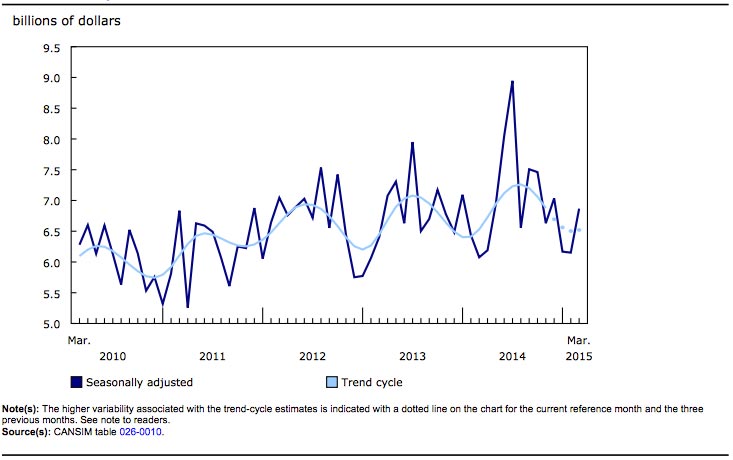
The total value of building permits rose 11.6% from a month earlier to $6.9 billion in March. This was the first increase in three months. Higher construction intentions for non-residential buildings in British Columbia and Alberta and for multi-family dwellings in Ontario and British Columbia were responsible for much of the advance at the national level.
Non-residential sector: strong increases in construction intentions for institutional and commercial buildings
The value of institutional building permits increased 73.9% to $661 million in March, partly offsetting the declines of the two previous months. Advances were posted in a variety of institutional buildings, including educational institutions, medical facilities as well as nursing and retirement homes. Gains were posted in seven provinces, led by Alberta, followed by British Columbia, Saskatchewan and Quebec.
In the commercial component, the value of permits was up 11.4% to $1.4 billion in March, after two straight monthly declines. Higher construction intentions for warehouses, hotels and restaurants, retail and wholesale outlets, as well as retail complexes, were responsible for the advance in the component at the national level. British Columbia, Alberta and Newfoundland and Labrador recorded increases, while Ontario registered the largest decline of the remaining seven provinces.
Municipalities issued industrial building permits worth $428 million in March, up 5.5% from the previous month. This was the second consecutive monthly advance. The increase was attributable to higher construction intentions for manufacturing plants and, to a lesser degree, utilities buildings. Advances were posted in seven provinces, led by British Columbia, followed by Quebec and Saskatchewan.

Residential sector: notable increase in construction intentions for multi-family dwellings
The value of permits issued for multi-family dwellings rose 19.6% to $2.1 billion in March, marking the second consecutive monthly gain. The increase was attributable to higher construction intentions in four provinces, led by Ontario and British Columbia. The largest declines were recorded in Quebec and Nova Scotia.
The value of single-family dwelling permits fell for a second consecutive month, down 3.4% to $2.3 billion in March. Gains in five provinces, led by Ontario and Quebec, were not sufficiently large to offset the declines in the remaining provinces, with Alberta registering the largest drop.
Canadian municipalities authorized the construction of 18,586 new dwellings in March, up 24.9% from the previous month. The increase stemmed from a 43.7% advance in the number of multi-family dwellings to 13,126 units. In contrast, the number of single-family dwellings declined 5.0% to 5,460 units.
Provinces: British Columbia, Ontario and Alberta post large increases
The total value of permits was up in six provinces in March, led by British Columbia, Ontario and Alberta.
Every building construction component increased in British Columbia, with multi-family dwellings, commercial and institutional buildings accounting for most of the gain. In Ontario, the increase was attributable to higher construction intentions for residential structures, mostly multi-family dwellings. In Alberta, the gain was the result of increased intentions for institutional and commercial buildings, as well as multi-family dwellings.
In contrast, Quebec posted the largest decrease, mainly as a result of lower construction intentions for multi-family dwellings, which rose 67.1% in February. In Nova Scotia, the decline was attributable to lower construction intentions for residential buildings, which posted a large increase the previous month.
Higher construction intentions in most census metropolitan areas
The total value of permits rose in 19 of the 34 census metropolitan areas, led by Vancouver, Toronto and Calgary.
The gain in Vancouver occurred mostly as a result of higher construction intentions for multiple dwellings and commercial buildings. In Toronto, which posted the largest decline a month earlier, the increase originated from residential structures, mainly multi-family dwellings. In Calgary, higher construction intentions for multi-family dwellings and institutional buildings explained the advance.
The largest decline was in Montréal, largely as a result of lower construction intentions for multi-family dwellings. This was the second decrease in three months.
Edmonton and Kitchener-Cambridge-Waterloo posted the next largest declines. In Edmonton, the decrease came from the residential sector, following three consecutive monthly increases. In Kitchener-Cambridge-Waterloo, every component contributed to the drop, with residential structures accounting for much of the decline.
Source: Statistics Canada, http://www.statcan.gc.ca/daily-quotidien/150507/dq150507a-eng.htm?cmp=mstatcan.