March Electrical Demand Drops 5.1% Year over Year
Economy Power 1

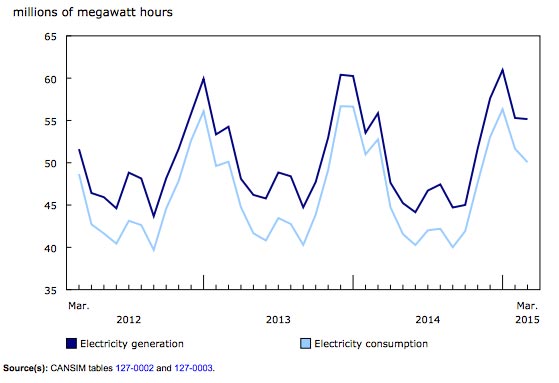
Canada’s demand for electricity in March totalled 50.1 million megawatt hours (MWh), down 5.1% from March 2014 levels. Lower demand in Quebec, Alberta and British Columbia contributed to the decline. With the drop in demand, electricity generation fell 1.3% to 55.2 million MWh.

Lower domestic demand also resulted in much weaker imports of electricity from the United States. Electricity imports in March declined 1.0 million MWh compared with March 2014 to 0.9 million MWh, while exports rose 20.6% to 6.0 million MWh.

Chart 1: Electricity generation and consumption

Canada’s decline in demand for electricity was led by lower demand in Quebec, down 7.5% to 20.1 million MWh in March. As a result, electric power generation levels declined 2.7% to 19.5 million MWh. With provincial demand dropping, Quebec decreased the amount of electricity purchased from both the United States and other provinces (-12.7%). At the same time, it increased deliveries south of the border and to other provinces, including Ontario, Newfoundland and Labrador and New Brunswick.

In New Brunswick, receipts from other provinces nearly doubled to 0.4 million MWh to meet provincial demand, as generation levels in the province fell 14.5% to 1.3 million MWh. Lower generation in New Brunswick was attributable to a maintenance outage at a generating station. In addition, New Brunswick exported 8.4% less electricity in March to meet provincial demand.

In Western Canada, both Alberta and British Columbia recorded double-digit declines in demand. In Alberta, demand fell 15.3% to 5.1 million MWh. In British Columbia, above average temperatures contributed to a 13.4% decline in demand to 5.0 million MWh, which helped push imports from the United States down 38.6%.

Chart 2: Total electricity available by province

Economy Chart 2

Demand in Ontario rose 6.8% to 11.3 million MWh in March, mitigating the national decline in demand for electric power. To meet increased demand, generation levels in the province grew 7.5% on a year-over-year basis to 13.2 million MWh. This was the sixth increase in generation levels in seven months, with gains over the period mainly attributable to nuclear power. With higher production levels, Ontario increased the amount of electricity sent to the United States by 35.3% to 2.2 million MWh in March.


 

Related Articles


Latest Articles

  • Ottawa Day 2026: EFC Members Engage with Parliamentarians on Canada’s Electricity Future

    Ottawa Day 2026: EFC Members Engage with Parliamentarians on Canada’s Electricity Future

    March 16, 2026 By Electro-Federation Canada Following EFC’s recent update on our 2026 Ottawa Day, we are pleased to share photo highlights from two days of engagement on Parliament Hill, where members met with federal decision-makers to discuss the future of Canada’s electricity system. More than 40 EFC member leaders and Government Relations representatives travelled Read More…

  • Industrial Construction Intentions Drive Increase in Non-Residential Sector in January

    Industrial Construction Intentions Drive Increase in Non-Residential Sector in January

    March 13, 2026 In January, the total value of building permits issued in Canada increased $607.0 million (+4.8%) to $13.3 billion. The increase was led by the non-residential sector (+$464.0 million) and supported by the residential sector (+$143.0 million). On a constant dollar basis (2023=100), the total value of building permits issued in January rose 4.3% from the previous month Read More…

  • Multi-Unit Construction Drives Growth in December Residential Construction Investment, 2025 Review

    Multi-Unit Construction Drives Growth in December Residential Construction Investment, 2025 Review

    March 13, 2026 The total value of investment in building construction increased $442.9 million (+1.9%) to $23.7 billion in December. The residential sector grew 2.4%, while the non-residential sector edged up 0.6%. Year over year, investment in building construction grew 12.2% in December. On a constant dollar basis (2023=100), the total value of investment in building construction in December rose 1.7% Read More…

  • 5 Strategic Reasons to Attend the Lumen Exhibition

    5 Strategic Reasons to Attend the Lumen Exhibition

    March 13, 2026 In a market where deadlines are tight and projects are increasingly complex, staying competitive is no longer just about technical skills. It also depends on having the right tools, the right information, and the right partners by your side. The Lumen Exhibition is more than just an event—it’s a strategic lever designed to Read More…


Changing Scene

  • A New Guillevin.com, Designed to Simplify Your Purchasing Experience

    A New Guillevin.com, Designed to Simplify Your Purchasing Experience

    March 16, 2026 Guillevin.com was built as a digital working tool, designed to support the way their customers plan, search for, and purchase products today. The goal is simple: to offer a fast, reliable, and intuitive online platform capable of supporting real-world operations; both on the job site and in the office. A platform built around Read More…

  • Nova Scotia Strengthens Housing Legislation to Accelerate Supply

    Nova Scotia Strengthens Housing Legislation to Accelerate Supply

    March 13, 2026 Amendments to existing legislation will mean more housing, improved efficiency in the sector and better alignment of related agencies. The changes extend the Executive Panel on Housing in the Halifax Regional Municipality and give the Minister of Housing new authority to ensure housing projects aren’t delayed. “We are strengthening how we plan, Read More…

  • BC Introduces Public Sector Construction Projects Procurement Act

    BC Introduces Public Sector Construction Projects Procurement Act

    March 13, 2026 Kiel Giddens, MLA for Prince George-Mackenzie and Critic for Labour, has introduced the Public Sector Construction Projects Procurement Act, legislation aimed at ensuring publicly funded construction contracts are awarded through labour-neutral, merit-based procurement. “Here’s the simple question: if labour shortages are driving cost overruns, why would government limit who can work on public projects?” Read More…

  • KPMG Establishes Major Products Delivery Office

    KPMG Establishes Major Products Delivery Office

    March 13, 2026 KMPG: Complex projects require well-structured teams, appropriate delivery models tailored to the project’s needs, robust governance frameworks, and stable execution environments KPMG Canada is entering a defining era of major project development that has significant implications for the nation’s economic future, as the country works to establish new trade partnerships, develop its resources, reinforce self-reliance Read More…