The Data Are In: Wind Energy Has Become the Leading Choice for New Electricity Generating Capacity
Wind Power Energy

Robert Hornung

Some critics of wind energy love to point out that while wind energy is making a significant and rapidly growing contribution to electricity generation in Canada and around the world, its overall contribution is still relatively small compared to conventional sources of electricity generation. What these critics fail to recognize is that the contribution made by conventional sources of electricity generation represent a historical legacy — they do not reflect modern investments in the electricity grid.


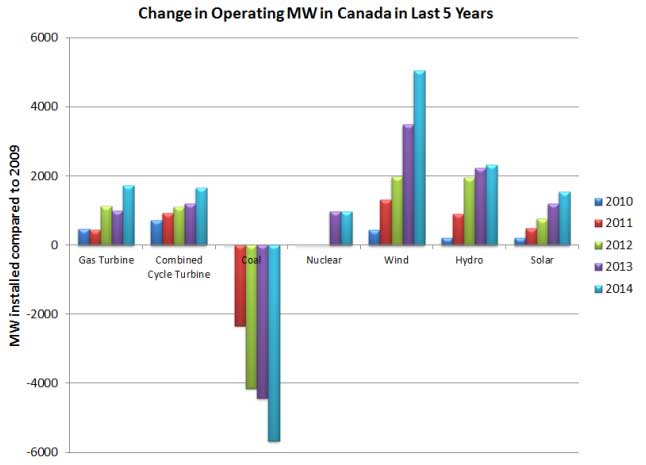
In Canada, for example, there has been more new wind energy capacity installed over the last five years (5,690 MW) than any other form of electricity generation — more than natural gas, hydro, nuclear or solar. Indeed, wind energy represents 38% of all new electric generation capacity installed from these sources in Canada in this period – and Canada’s coal-fired generating capacity has actually fallen at the same time.

A similar trend is evident in the United States, where wind energy was the largest source of new electricity generation in 2014 and represented 28 per cent of all new electricity generation capacity additions in the United States between 2010-2014 — second only to natural gas.

These trends have been in place even longer in the European Union. According to Wind Power in Europe, wind energy was not only the leading source of new electricity generation in 2014 (representing 44% of new installed capacity), it has been the largest source of new electricity generating capacity in Europe over the last 15 years. Between 2000-2014, there were 117 GW of new wind energy capacity installed in Europe, 101 GW of new natural gas fired capacity and 88 GW of new solar capacity. Over that same time period, nuclear generating capacity in Europe fell by 13 GW and coal-fired generation fell by 25 GW.

We are now at the leading edge of a fundamental transformation of global electricity systems that is creating systems that are more diverse, decentralized and low carbon. As the data show, wind energy has been, and will continue to be, a leader in that transformation because of its cost competitiveness, environmental attributes, scalability, and local economic benefits.

*Canadian data on capacity additions are from the National Energy Board (which underestimates capacity additions for wind energy). Data on capacity additions for solar energy was provided by the Canadian Solar Industries Association.

Robert Hornung is President of the Canadian Wind Energy Association. This article was first published by CanWEA on its website: http://canwea.ca/the-data-is-in-wind-energy-has-become-the-leading-choice-for-new-electricity-generating-capacity/


Related Articles


Latest Articles

  • Ottawa Day 2026: EFC Members Engage with Parliamentarians on Canada’s Electricity Future

    Ottawa Day 2026: EFC Members Engage with Parliamentarians on Canada’s Electricity Future

    March 16, 2026 By Electro-Federation Canada Following EFC’s recent update on our 2026 Ottawa Day, we are pleased to share photo highlights from two days of engagement on Parliament Hill, where members met with federal decision-makers to discuss the future of Canada’s electricity system. More than 40 EFC member leaders and Government Relations representatives travelled Read More…

  • Industrial Construction Intentions Drive Increase in Non-Residential Sector in January

    Industrial Construction Intentions Drive Increase in Non-Residential Sector in January

    March 13, 2026 In January, the total value of building permits issued in Canada increased $607.0 million (+4.8%) to $13.3 billion. The increase was led by the non-residential sector (+$464.0 million) and supported by the residential sector (+$143.0 million). On a constant dollar basis (2023=100), the total value of building permits issued in January rose 4.3% from the previous month Read More…

  • Multi-Unit Construction Drives Growth in December Residential Construction Investment, 2025 Review

    Multi-Unit Construction Drives Growth in December Residential Construction Investment, 2025 Review

    March 13, 2026 The total value of investment in building construction increased $442.9 million (+1.9%) to $23.7 billion in December. The residential sector grew 2.4%, while the non-residential sector edged up 0.6%. Year over year, investment in building construction grew 12.2% in December. On a constant dollar basis (2023=100), the total value of investment in building construction in December rose 1.7% Read More…

  • 5 Strategic Reasons to Attend the Lumen Exhibition

    5 Strategic Reasons to Attend the Lumen Exhibition

    March 13, 2026 In a market where deadlines are tight and projects are increasingly complex, staying competitive is no longer just about technical skills. It also depends on having the right tools, the right information, and the right partners by your side. The Lumen Exhibition is more than just an event—it’s a strategic lever designed to Read More…


Changing Scene

  • Blackstone Announces Agreement to Acquire Arlington Industries

    Blackstone Announces Agreement to Acquire Arlington Industries

    March 20, 2026 Blackstone and Arlington Industries announced that funds managed by Blackstone Energy Transition Partners have entered into a definitive agreement to acquire Arlington. Founded in 1949, Arlington designs and manufactures a range of electrical products such as fittings, enclosures and other components. The company’s innovative solutions are used across commercial, industrial and data Read More…

  • A New Guillevin.com, Designed to Simplify Your Purchasing Experience

    A New Guillevin.com, Designed to Simplify Your Purchasing Experience

    March 16, 2026 Guillevin.com was built as a digital working tool, designed to support the way their customers plan, search for, and purchase products today. The goal is simple: to offer a fast, reliable, and intuitive online platform capable of supporting real-world operations; both on the job site and in the office. A platform built around Read More…

  • Nova Scotia Strengthens Housing Legislation to Accelerate Supply

    Nova Scotia Strengthens Housing Legislation to Accelerate Supply

    March 13, 2026 Amendments to existing legislation will mean more housing, improved efficiency in the sector and better alignment of related agencies. The changes extend the Executive Panel on Housing in the Halifax Regional Municipality and give the Minister of Housing new authority to ensure housing projects aren’t delayed. “We are strengthening how we plan, Read More…

  • BC Introduces Public Sector Construction Projects Procurement Act

    BC Introduces Public Sector Construction Projects Procurement Act

    March 13, 2026 Kiel Giddens, MLA for Prince George-Mackenzie and Critic for Labour, has introduced the Public Sector Construction Projects Procurement Act, legislation aimed at ensuring publicly funded construction contracts are awarded through labour-neutral, merit-based procurement. “Here’s the simple question: if labour shortages are driving cost overruns, why would government limit who can work on public projects?” Read More…