Lockout Failure Kills One Worker, Injures Another
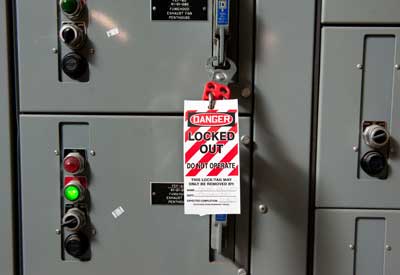
A general contracting firm and two supervisors have been fined a combined $133,000 after a lockout incident in which one worker died and the other sustained injuries.Lockout is a means of preventing power from being applied to equipment, ensuring it cannot be set in motion.
The two workers, employed by a sub-contractor, were insulating an overhead water pipe in a Toronto Transit Commission (TTC) garage in Concord, ON. It was their first day on the job. The general contracting firm had two site superintendents supervising the project.
The workers were working from a scissor lift — a self-propelled elevating work platform. When an electric eye triggered a partially lowered overhead garage door to open, the door knocked the scissor lift over, causing both workers to fall 20 feet to the concrete floor below.
Here’s what went wrong:
• the two workers disregarded instructions from the supervisors to stay away from the raised overhead door, which was preventing them from insulating the section of pipe passing above it. One of the supervisors had told them that only TTC personnel could operate mechanical equipment, and that he would make arrangements with the designated TTC inspector. Eventually the workers asked a TTC worker to lower it part way.
• the TTC worker did not follow TTC lockout procedures, neither locking out the controls to the door nor consultingthe designated TTC inspector about lowering or locking it out.
• A few minutes after the scissor lift was moved into a position behind the partially lowered door, anotherTTC employee pushed a cart through the open doorway, which triggered an electric eye that caused the door to raise. The door knocked the lift over as it rolled along an overhead track.
This incident highlights the importance of
• ongoing supervision, especially when dealing with new workers and in an unfamiliar workplace
• strict adherence to all safety policies and procedures
The general contracting firm was fined $125,000. The firm’s two supervisors were fined $4,000 each.
Follow these lockout principles
Ontario’s Ministry of Labour advises employers, supervisors and workers to follow accepted lockout principles, including:
• pre-planning for the lockout by identifying all energy sources, switches, etc.
• where lockout is complex, preparing in checklist form a written sequence for equipment access, lockout/tagout, clearance, release, and start-up
• notifying all workers affected by the lockout
• shutting down equipment by normal means, e.g.,turning switches, closing valves…
• isolating equipment from energy sources by disconnecting or blocking the sources of energy
• lockingout and tagging the energy isolating devices by padlock or some other locking device that the worker has control over as well as a tag indicating that the equipment has been shut down
• verifying that all energy sources have been isolated by attempting to cycle the equipment prior to working on it
• releasing equipment from lockout when work is completed
• testing equipment