August Electricity Consumption Dips 2.9% YOY
Electric Power Stats

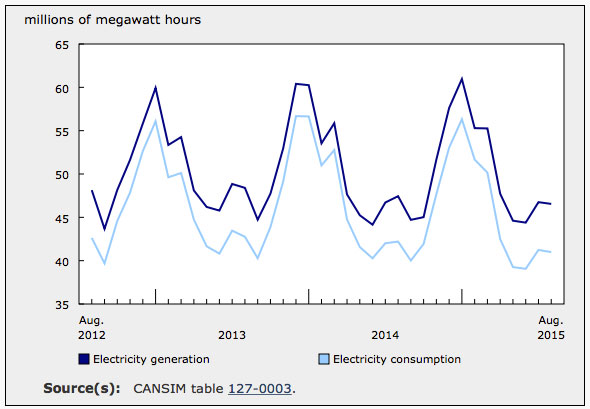
 Chart 1: Electricity generation and consumption, August 2012-2015


Canada’s available electricity totalled 41.0 million megawatt hours (MWh) in August, down 2.9% from the same month in 2014. Generation levels were also lower for the month, down 1.9% to 46.5 million MWh, reflecting lower output fin some provinces rom hydro and nuclear generators.

Canada’s electricity exports to the United States increased 1.8% to 6.2 million MWh on higher deliveries from British Columbia. Imports fell by nearly a quarter on a year-over-year (YOY) basis to 0.6 million MWh. Lower receipts from the United States were widespread with British Columbia posting the largest decline.

In Ontario, electric power generation levels totalled 11.8 million MWh in August, a 5.8% decrease compared with the same month in 2014. Lower water inflows to generating stations pushed hydro generation down 24.3% to 2.2 million MWh, more than offsetting small gains in steam conventional, nuclear, solar and wind generation. Lower generation, combined with higher net outflows, pushed total available electricity in August down 7.2% to 10.5 million MWh.

On the east coast, maintenance shutdowns at a nuclear power plant in New Brunswick resulted in a 27.3% decrease in total generation levels, which fell to 0.8 million MWh. Mitigating the decline, output from hydro, combustion turbine and steam conventional generators rose by more than 9% (in each case) on a year-over-year basis. To meet demand, the province increased receipts from other provinces, principally Quebec.

Generation gains of 7.7% in British Columbia and 18.9% in Newfoundland and Labrador eased the national decline in generation levels. Both provinces used their higher generation levels to increase deliveries; exports from British Columbia to the United States rose 57.6%, while deliveries from Newfoundland and Labrador to other provinces were up 27.6%.

Source: Statistics Canada, http://www.statcan.gc.ca/daily-quotidien/151027/dq151027b-eng.htm?cmp=mstatcan.

Related Articles


Latest Articles

  • What 2025 Revealed About Canada’s Electrical Industry

    What 2025 Revealed About Canada’s Electrical Industry

    December 16, 2025 By Carol McGlogan, President & CEO, Electro-Federation Canada The past year required Canada’s electrical industry to adapt to a rapidly changing environment. In 2025, businesses across the value chain navigated shifting trade conditions, evolving policy landscapes, and growing expectations tied to electrification and infrastructure expansion. Trade uncertainty introduced new complexity. Organizations reassessed… Read More…

  • Considerations for EV Charging Installation and Site Preparation

    Considerations for EV Charging Installation and Site Preparation

    December 15, 2025 By Blake Marchand As part of our recent discussion with LEDVANCE EVSE Product Manager, Erich Bockley, he emphasized the importance of site preparation Site preparation can be the most complicated part of the project, Bockley emphasized, a lot needs to be considered before the installation work begins. Many public charging applications will… Read More…

  • Ontario’s Multi-Family Component Leads Residential Sector Increases in October Building Permits

    Ontario’s Multi-Family Component Leads Residential Sector Increases in October Building Permits

    December 15, 2025 In October, the total value of building permits issued in Canada rose $1.8 billion (+14.9%) to $13.8 billion. The increase in construction intentions was led by the residential sector (+$1.1 billion). An increase was also observed in the non-residential sector (+$702.8 million). On a constant dollar basis (2023=100), the total value of building permits issued in… Read More…

  • Residential Investment in Building Construction Declines in September

    Residential Investment in Building Construction Declines in September

    December 15, 2025 Overall, investment in building construction decreased 1.1% to $22.4 billion in September. Investment in the residential sector declined 1.7%, while that in the non-residential sector was virtually unchanged. Year over year, investment in building construction grew 6.0% in September. On a constant dollar basis (2023=100), the total value of investment in building construction in September decreased 1.4%… Read More…


Changing Scene