Building Permits Rise 11.3% in December
Feb 12, 2016
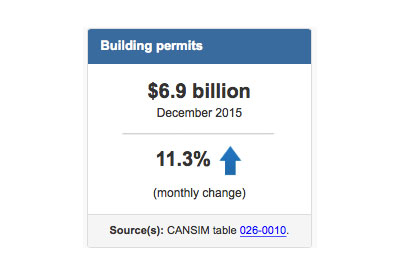
The total value of building permits issued by Canadian municipalities rose 11.3% to $6.9 billion in December, following a 19.9% decline the previous month. Higher construction intentions for multi-family dwellings in Quebec, Ontario, British Columbia and Alberta explained the advance.
Chart 1: Total value of permits

Construction intentions in the residential sector increased 16.3% to $4.7 billion in December, following a 17.9% decline the previous month. Gains were posted in every province except Saskatchewan. Higher construction intentions for multi-family dwellings led the advance.
Municipalities issued $2.3 billion worth of non-residential building permits in December, up 2.5% over the previous month. This increase followed a 23.2% decline in November. An increase in the value of commercial permits more than offset decreases in the institutional and industrial components. Six provinces reported gains, led by Alberta.
Residential sector: Higher construction intentions for multi-family dwellings behind the advance
The value of building permits for multi-family dwellings rose 39.1% to $2.3 billion in December, following a 33.8% decline in November. Higher construction intentions were reported in nine provinces, led by Quebec, Ontario, British Columbia and Alberta. Newfoundland and Labrador was the lone province to post a decline.
The value of permits for single-family dwellings edged down 0.1% from November, remaining fairly stable at around $2.3 billion for the fourth consecutive month. Advances in seven provinces failed to offset declines in the three other provinces. Saskatchewan posted the largest decrease.
Municipalities approved the construction of 17,506 new dwellings in December, up 16.5% from the previous month. The gain mainly resulted from multi-family dwellings, which increased 25.6% to 11,816 new units. Single family dwellings were up 1.3% to 5,690 new units.
Chart 2: Residential and non-residential sectors

Non-residential: Gain attributable to higher commercial building intentions
Following a notable decline the previous month, the value of non-residential building permits rose 2.5% to $2.3 billion in December. Gains in commercial construction intentions more than offset decreases in the institutional and industrial components.
After three consecutive monthly declines, construction intentions for commercial buildings rose 14.6% to $1.3 billion in December. The advance was largely the result of higher construction intentions for retail complexes and, to a lesser extent, storage buildings and research centres. Increases were posted in five provinces, led by Ontario and British Columbia. The largest declines were in Alberta and Quebec.
The value of permits in the industrial component fell 3.2% to $405 million in December, a third consecutive monthly decline. Lower construction intentions for manufacturing plants, minor industrial projects and maintenance buildings accounted for the majority of the decline. The decreases in Ontario and British Columbia more than offset the gains reported elsewhere.
Institutional construction intentions declined for a second consecutive month, down 13.6% to $594 million in December. The decrease at the national level was largely the result of lower construction intentions for medical facilities and elementary schools. Declines were posted in seven provinces, with Quebec recording the largest decrease, followed by Ontario and British Columbia. Alberta recorded a notable gain in the value of permits for institutional structures.
Provinces: Alberta, Ontario and British Columbia post notable gains
The total value of building permits was up in eight provinces in December, with Alberta posting the largest gain, followed by Ontario and British Columbia.
In Alberta, the value of building permits was up 26.0% to $1.2 billion in December, following a 56.3% decline the previous month. The gain was attributable to higher construction intentions in both the non-residential and residential sectors, led by institutional structures and multi-family dwellings.
Ontario municipalities issued $2.7 billion worth of building permits in December, up 5.7% from a month earlier. Higher construction intentions for multi-family dwellings and commercial buildings largely explained the advance.
The total value of building permits in British Columbia rose 12.5% to $1.2 billion in December, the third consecutive monthly gain. Higher construction intentions for multi-family dwellings and commercial buildings were responsible for the monthly increase.
Higher construction intentions in most census metropolitan areas
In December, the total value of building permits was up in 20 of the 34 census metropolitan areas, with Toronto registering the largest increase, followed by Calgary and Montreal.
In Toronto, the gains resulted mainly from higher construction intentions for multi-family dwellings and, to a lesser extent, commercial buildings. In Calgary, higher intentions for multi-family dwellings and industrial buildings were responsible for the advance.
Montreal reported higher building intentions for multi-family dwellings, which offset declines in every other component.
Annual 2015
The value of building permits in 2015 totalled $85.0 billion, unchanged from 2014. While residential construction intentions rose 4.4%, the growth was offset by a 6.3% decline in the non-residential component.
Residential: higher construction intentions for multi-family dwellings explain the increase
Residential building permits issued by municipalities were up 4.4% from the previous year to $53.2 billion in 2015, continuing the upward trend started after the declines in 2008 and 2009. In 2015, the value of residential permits rose in three provinces: Ontario, British Columbia and Nova Scotia. Alberta (-8.9%) reported the largest decline, its first decrease since 2009.
Non-residential: declines in all three components, led by commercial buildings
Construction intentions in the non-residential sector declined 6.3% from 2014 to $31.8 billion in 2015. Decreases were posted in every component, led by commercial buildings. Six provinces reported lower construction intentions for non-residential buildings. Institutional building permits in Quebec posted the largest decline.