Going Green in Nature
Line Goyette
Bonaventure Island, part of Quebec’s Bonaventure Island and Percé Rock National Park off the coast of Gaspé, receives 50,000 visitors each summer. This year the park celebrates its 30th anniversary. People come to this island for its built heritage (a reflection of the historic French fishery that lasted until the dawn of the 20th century) and its 572 species of plants, but above all the island is one of North America’s largest migratory bird sanctuaries, including the world’s most spectacular and accessible colony of Northern Gannets (100,000). Welcoming visitors to the island are an information centre, restaurant and shop. About 50 employees are on hand to host these visitors and maintain the park.
Why go green in a national park?
“Five years ago, we adopted an environmental management plan. We wanted to reduce our environmental footprint while taking into account our needs and the services we offer visitors,” says Rémi Plourde, the park’s director. “We have therefore implemented a series of measures ranging from purchasing bikes for students to using compostable dishes at the island’s restaurant. But our energy needs continued to grow and we could no longer use gas generators to meet these needs.”
 While the island can’t be connected to the province’s electrical grid, it enjoys abundant sunshine, and the park’s thinking quickly turned to solar panels as an energy source. “After evaluating our needs— lighting, cash registers, thematic displays related tothe Internet, maintenance vehicles — solar energy became our first choice.”
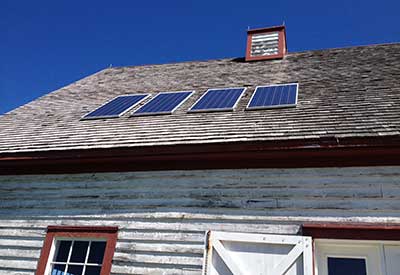
The building that houses the restaurant and shop is now equipped with four 400-Watt solar panels supplying a 24-volt system. Batteries assure a few days of power if ever the sun is stingy. Three more solar panels on the information centre help to power a dynamic screen connected to the Internet and the park’s electric vehicles.

“At little cost, and with a smaller environmental footprint, we were able to improve what we offer our visitors. Our staff members installed everything themselves this spring. Solar technology is by far best the best fit for our mandate,”continues RémiPlourde. The region is in the heart of wind energy development, but the presence of birds makes it impossible to use this technology.
The arrival of solar energy is now enabling Plourde and his team to develop other projects that promote the island, such as restoring the heritage homes as accommodation for overnight visitors. Washroom facilities will also be included in the island’s service zone.
“Customers notice the solar panels, which make the park is an ideal place to raise awareness of clean energy,”concludes the park’s director.
Line Goyette is Managing Editor of EIN; linegoyette@kerrwil.com @linegoyette
More articles by this author:
David Nathaniel: A Talent for Being There at the Right Time
Stelpro: One Among Canada’s Best Managed Companies
Behind the Scene: A New Solution for Connecting Consumers with Their Utilities
Patrice Jomphe — EFC Québec Region’s 2013 Personality of the Year