Adaptive Lighting Systems Part 2: Daylight Harvesting
May 16, 2016
Continuing our review of advanced lighting control strategies enabling smart and adaptive lighting systems, this time we’ll look at what is known as daylight harvesting. While not as widely used as occupancy sensing, daylight harvesting is one of the most powerful techniques for cutting lighting energy usage. Because of its strong energy savings potential, it is required by an increasing number of energy codes and standards — so we can expect to see daylighting systems being deployed more and more often these days as building owners implement measures aimed at meeting current demands for environmental sustainability.
The concept behind daylight harvesting is very straightforward and not that much different from what occupancy sensing is all about. Both of these strategies aim to reduce the lighting system output whenever this can be done without deterioration of working/living conditions in a given space, although they achieve this in a radically different way. Occupancy sensing turns the lights down/off when the space remains unoccupied, while daylight harvesting does the same when lighting needs are, at least partially, met by the natural light entering the room.
Just like in the case of occupancy sensing, a lighting system employing the daylight harvesting strategy must be able to track and interpret certain changes in the environment, so that it can make autonomous decisions that optimize its performance. Therefore, it must constantly be fed with relevant data upon which such decisions can be made. These data come from sensors, again, but instead of motion sensors, photosensors are used. They can measure either solely the amount of available daylight (open-loop systems), or the total amount of light in a given space, taking into account both daylight and electric light (closed-loop systems). The former can be installed both outside and inside the space, but when located inside they need to face a window or a skylight in order to ensure adequate readings. The latter must be installed inside the space, e.g., directly above the work surface.
Similarly to occupancy sensing, daylight harvesting can be implemented in several different ways. While deciding which approach to take, a number of factors need to be considered, including the size and type of space, the arrangement of lighting fixtures and windows, occupants’ needs, etc. In general, more sophisticated setups can produce bigger benefits, although in certain types of spaces even a simple model might be good enough. And beyond any doubt, even the most elementary daylight harvesting strategy is a big step towards energy efficiency and sustainability, as it can turn natural light into a valuable and tangible asset for almost any type of commercial space.
The simplest daylighting scenario is the one where lights are turned off as soon as the amount of daylight meets a minimum desired level. Once it gets dark outside, lights are turned back on. Certain delay mechanisms are included to prevent lights from switching on/off multiple times over a short period of time, so switching will usually occur only twice a day — at the beginning and at the end of it. No heavy investments required, a single photosensor measuring the amount of available daylight could easily handle the entire space or a number of spaces, ensuring that lights don’t stay on in areas that are fully illuminated by sunlight during the daytime.
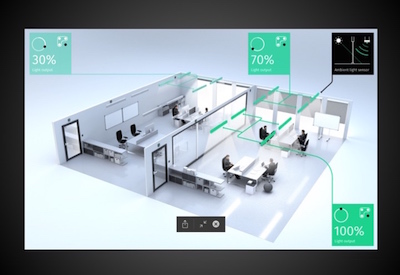
However, a daylighting strategy becomes way more effective once autonomous dimming is incorporated into it. In such case, the amount of artificial light generated by fixtures is being continuously adjusted in proportion to the amount of daylight available. A desired light level, appropriate for a given space and tasks carried out there, is maintained at all times. This way, even the tiniest amount of available daylight is being used, reducing the total output of the entire lighting system. But since the distribution of daylight throughout rooms is rarely uniform, a truly optimized performance can be obtained once the space is divided into separate zones, each with its own photosensor providing precise ambient light level measurements for a given area. Zoning ensures maximum responsiveness of the lighting system to daylight availability across different parts of the room, increasing energy savings even further and providing appropriate lighting conditions for all occupants. In the most sophisticated scenario, sensors can be integrated into lighting fixtures so that each of them operates independently, adjusting light output to lighting conditions in its immediate vicinity. The picture above presents what such an arrangement might look like in a small office space.
When used properly, daylight harvesting can produce a number of benefits both for building owners and occupants. In addition to significant energy savings, this lighting control strategy is capable of delivering precisely defined lighting conditions across the entire space, so that it’s never too dark or too bright. Combining daylight and artificial light provides a constant, optimized lighting environment that improves occupant wellbeing. For most of the time they spend in a particular space, they can enjoy the warmth of natural light, while not having to deal with unnecessary light pollution generated by luminaires. And while the impact of various types of light on humans isn’t fully known yet, there is strong evidence showing that people exposed to natural light tend to be more productive and relaxed than those exposed to artificial lighting. Finally, there is the convenience factor, which shouldn’t be overlooked in the fast-paced commercial environment. Since the lighting system autonomously adjusts its output at all times, occupants do not have to bother with manual adjustments whenever the amount of available daylight increases or drops.
The scale of energy savings can vary strongly, depending on the type of space and the type of the deployed daylight harvesting strategy. In most scenarios, lighting energy consumption drops by 25%-50%, with the biggest potential for savings to be found in office spaces, classrooms, etc. The rule is pretty simple: the more natural light is available in a given space, the more money can be saved by deploying a daylight harvesting system. An important thing to note is that daylight harvesting effectively reduces the building’s peak energy demand, since it generates the biggest energy savings during the period of the highest daylight availability, which is also the period of peak air conditioning demand.
Just like in the case of occupancy sensing, there are no major differences between how wired and wireless daylight harvesting systems work. But there is a huge gap between the effort required to implement each of them. So far, a widespread adoption of daylight harvesting strategies has been hampered by high installation costs. Deploying a well-tuned daylight harvesting system in an existing office building requires a lot of work if traditional wired solutions are to be used. Miles of cables need to be put in place and hidden out of sight only to build a clunky architecture requiring intervention of a specialist whenever any of the nodes performs below expectations or any adjustments need to be made for whatever reason. Smart lighting is a different story, though.
Once smart bulbs have been deployed in a given space, the building owner/administrator only needs to attach wireless photosensors in appropriate locations to enable a fully operational daylight harvesting system, one that can be easily adjusted over time in accordance with occupants’ needs and the way a given space is used. This is why smart lighting has the potential to fully open up the lighting retrofit business.
The flexibility of wireless technologies also eliminates the problem of improper setup or installation. Should occupants discover that the system performs below expectations (e.g., by not providing certain areas with enough light at certain times of the day), the setup can be swiftly modified via relevant settings in the smartphone app. If an inappropriate location of certain photosensors is the cause of the problem, then those sensors can be moved around very easily. There are no wires involved so any physical adjustments can be implemented with almost no effort, while logical adjustments (grouping of bulbs and sensors, desired light level across the room, etc.) can be introduced via smartphone app.
An important thing about advanced lighting control strategies is that the more of them used, the bigger benefits can be obtained. Most of these techniques complement each other very well, and the occupancy sensing & daylight harvesting tandem is a perfect example. Once both of these strategies are implemented, a lighting system becomes truly responsive and efficient. First of all, bulbs turn on only when a given space is being used. Second, they add only as little artificial light as required to establish comfortable lighting conditions, making the best possible use of the available natural sunlight. Once deployed in tandem, these two advanced lighting control strategies ensure that every single bulb delivers light only when it has a good reason to do so. That’s a radical departure from what still remains a common approach to office lighting, and a big opportunity for slashing the building’s electricity bills and improving its environmental footprint.
But striving for ultimate energy efficiency, adaptive lighting systems can take into account more factors than just occupancy and daylight availability. In our next post, we’ll take a look at what else they can do.
This article first appeared as a Silvair blog post. Silvair’s team of software developers, hardware engineers, UX designers, product managers and testers are building a growing network of products that are truly smart and user friendly: www.silvair.com.