Global Revenue Forecast to Reach US$35.6 Billion in 2024

Industrial Energy Management

North America and Europe will lead the industrial energy management system (IEMS) market in terms of revenue, says a new report from Navigant Research.

The need for continuity in operations and production has made energy efficiency a lower priority in industrial facilities compared to commercial buildings, despite their status as some of the most energy-intensive buildings worldwide. However, as executives begin to understand the value of enhanced visibility and insight into enterprise performance and site-level strategic energy management, the business case for IEMSs is growing. Navigant estimates global IEMS revenue is expected to grow from US$13.5 billion in 2015 to US$35.6 billion in 2024.

“Industrial customers are struggling to recover from the economic crisis and, in many cases, are targeting higher production with fewer resources,” says Casey Talon, senior research analyst with Navigant Research. “IEMSs can offer tools for managing costs, hedging risks associated with price volatility and policy impacts, and achieving corporate social responsibility and sustainability commitments.”

Because of increasing customer demand for IEMS software and services, Navigant Research projects this market will grow aggressively during the next decade, according to the report. The North American and European markets are expected to continue to lead the market in terms of revenue, while Asia Pacific is expected to experience the fastest growth.

The report, Industrial Energy Management Systems, analyzes two segments of the global IEMS market: software and services. The study provides an analysis of the market issues, including business cases, opportunities, and implementation challenges. Global market forecasts for revenue, broken out by segment and region, extend through 2024. The report also examines the key aspects of IEMS solutions, specifically software functionality and service offerings, as well as the competitive landscape.

Find out more: http://www.navigantresearch.com/research/industrial-energy-management-systems.

Related Articles


Latest Articles

  • What 2025 Revealed About Canada’s Electrical Industry

    What 2025 Revealed About Canada’s Electrical Industry

    December 16, 2025 By Carol McGlogan, President & CEO, Electro-Federation Canada The past year required Canada’s electrical industry to adapt to a rapidly changing environment. In 2025, businesses across the value chain navigated shifting trade conditions, evolving policy landscapes, and growing expectations tied to electrification and infrastructure expansion. Trade uncertainty introduced new complexity. Organizations reassessed… Read More…

  • Considerations for EV Charging Installation and Site Preparation

    Considerations for EV Charging Installation and Site Preparation

    December 15, 2025 By Blake Marchand As part of our recent discussion with LEDVANCE EVSE Product Manager, Erich Bockley, he emphasized the importance of site preparation Site preparation can be the most complicated part of the project, Bockley emphasized, a lot needs to be considered before the installation work begins. Many public charging applications will… Read More…

  • Ontario’s Multi-Family Component Leads Residential Sector Increases in October Building Permits

    Ontario’s Multi-Family Component Leads Residential Sector Increases in October Building Permits

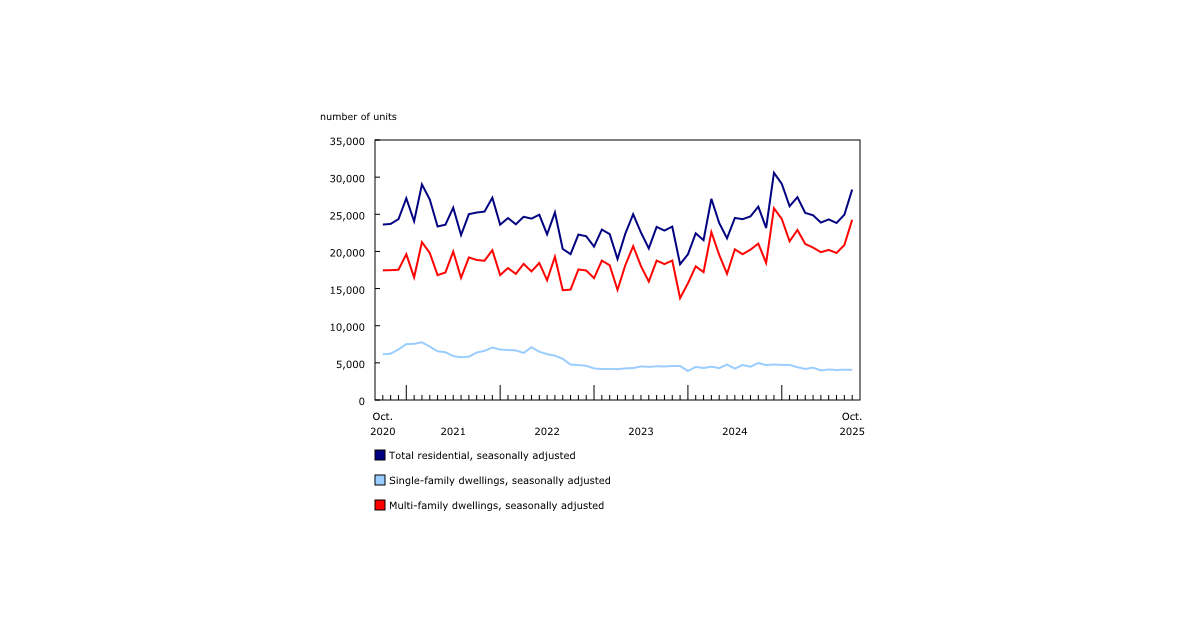
    December 15, 2025 In October, the total value of building permits issued in Canada rose $1.8 billion (+14.9%) to $13.8 billion. The increase in construction intentions was led by the residential sector (+$1.1 billion). An increase was also observed in the non-residential sector (+$702.8 million). On a constant dollar basis (2023=100), the total value of building permits issued in… Read More…

  • Residential Investment in Building Construction Declines in September

    Residential Investment in Building Construction Declines in September

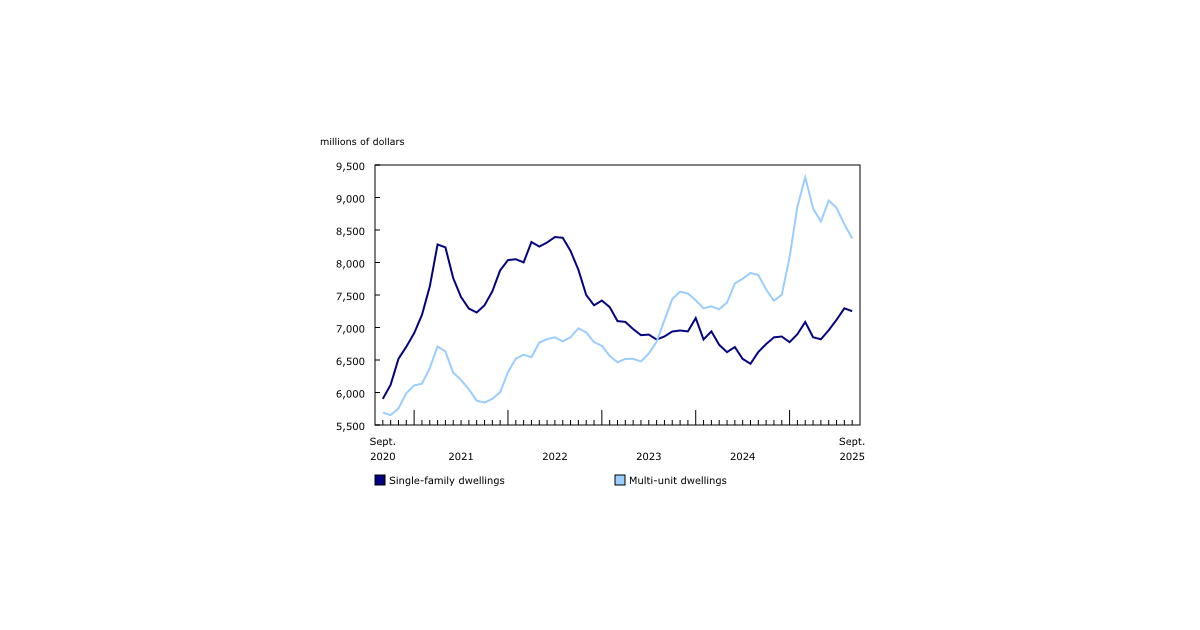
    December 15, 2025 Overall, investment in building construction decreased 1.1% to $22.4 billion in September. Investment in the residential sector declined 1.7%, while that in the non-residential sector was virtually unchanged. Year over year, investment in building construction grew 6.0% in September. On a constant dollar basis (2023=100), the total value of investment in building construction in September decreased 1.4%… Read More…


Changing Scene