Top 5 Optical Fibre Myths

March 30 2016

Luis Cardenas

Optical fibre has been the backbone of Internet infrastructure for years and almost all our communications rely on it: telephony services, Wi-Fi or CATV. It is also responsible for building-to-building connectivity in campuses and is used in a variety of military applications. But still there are some myths about this incredible technology and we’d like to expose them.

1. Fibre is fragile

Yes, glass used in everyday products is easy to break, but although optical fibre is as thin as a human hair it is actually stronger  than copper. Optical fibre cables are designed to resist the roughest installations, tolerating higher temperature levels and withstanding more than 200 pounds of pulling tension.

2. Installations are challenging

Fibre may have been difficult to install many years ago, when connectors had to be polished and terminations needed to be done by hand. Nowadays, technology improvements have made it easy to install and to test.

3. Fibre doesn’t support wireless

Due to optical fibre large bandwidth capacity and its long -term compatibility with networking hardware, telecoms rely on optical fibre to transmit wireless mobile signals from towers to central networks. So if you are reading this article on your phone, it’s probably thanks to optical fibre technology.

4. You can’t bend it

It’s true that fibre was sensitive to bending, but that changed some years back with the introduction of insensitive fibre, a kind of fibre in which an optical trench was constructed into it to reflect light back into the core. This type of fibre is perfect to be used in hard to reach places without affecting its performance.


5. Fibre is more expensive than copper

When considering the entire structure, fibre ends up being cheaper than copper. Fibre networks need less equipment, therefore they consume less power, which means lower costs over the long term. Also, optical fibre maintenance costs are less than copper’s.


With information from Corning. This article first appeared as a blog. Source: Beyondtech, Inc.

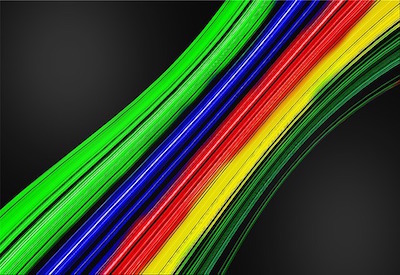
Photo of fibre optic cables courtesy of pixabay: pixabay.com/en/fiber-optic-cable-rainbow-colors-246272/.


Related Articles


Latest Articles

  • What 2025 Revealed About Canada’s Electrical Industry

    What 2025 Revealed About Canada’s Electrical Industry

    December 16, 2025 By Carol McGlogan, President & CEO, Electro-Federation Canada The past year required Canada’s electrical industry to adapt to a rapidly changing environment. In 2025, businesses across the value chain navigated shifting trade conditions, evolving policy landscapes, and growing expectations tied to electrification and infrastructure expansion. Trade uncertainty introduced new complexity. Organizations reassessed… Read More…

  • Considerations for EV Charging Installation and Site Preparation

    Considerations for EV Charging Installation and Site Preparation

    December 15, 2025 By Blake Marchand As part of our recent discussion with LEDVANCE EVSE Product Manager, Erich Bockley, he emphasized the importance of site preparation Site preparation can be the most complicated part of the project, Bockley emphasized, a lot needs to be considered before the installation work begins. Many public charging applications will… Read More…

  • Ontario’s Multi-Family Component Leads Residential Sector Increases in October Building Permits

    Ontario’s Multi-Family Component Leads Residential Sector Increases in October Building Permits

    December 15, 2025 In October, the total value of building permits issued in Canada rose $1.8 billion (+14.9%) to $13.8 billion. The increase in construction intentions was led by the residential sector (+$1.1 billion). An increase was also observed in the non-residential sector (+$702.8 million). On a constant dollar basis (2023=100), the total value of building permits issued in… Read More…

  • Residential Investment in Building Construction Declines in September

    Residential Investment in Building Construction Declines in September

    December 15, 2025 Overall, investment in building construction decreased 1.1% to $22.4 billion in September. Investment in the residential sector declined 1.7%, while that in the non-residential sector was virtually unchanged. Year over year, investment in building construction grew 6.0% in September. On a constant dollar basis (2023=100), the total value of investment in building construction in September decreased 1.4%… Read More…


Changing Scene