Building Permits Rose 0.4% in September
Nov 11, 2018
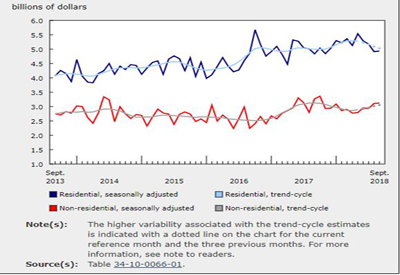
Canadian municipalities issued $8.1 billion worth of building permits in September, up 0.4% from August. The national increase was driven by higher construction intentions in Quebec.
Non-residential sector: higher construction intentions for institutional buildings.
The value of building permits in the non-residential sector was up 0.6% to $3.1 billion in September, due to higher construction intentions for institutional buildings.
In the institutional component, the value of building permits rose 16.4% from August to $806 million. The increase in the value of permits mainly stemmed from post-secondary institutions and nursing homes. Six provinces reported gains, led by Quebec.
In the commercial component, $1.7 billion worth of permits were issued in September, down 3.3% from the previous month. Permits for office buildings accounted for the majority of the decline. Five provinces reported decreases, with the largest drop in British Columbia.
The value of building permits in the industrial component fell 5.7% to $636 million. Five provinces reported declines, with the most significant decreases in Quebec and British Columbia.
Residential sector: gains driven by the multi-family dwelling component
In the residential sector, the value of building permits edged up 0.3% to $4.9 billion, posting the first increase in four months. Higher construction intentions for multi-family dwellings contributed to the rise.
In the multi-family dwelling component, the value of permits rose 1.5% to $2.7 billion. The increase was led by Quebec, where $752 million worth of building permits were issued, up 49.1% from August.
The value of building permits for single-family dwellings was down 1.2% to $2.2 billion in September, the fourth consecutive monthly decrease. Four provinces reported declines, most notably Ontario and Alberta.
Municipalities approved the construction of 19,073 new dwellings in September, up 7.8% from August. The increase was attributable to both single-family (+3.3%) and multi-family (+9.4%) dwellings.
Provinces and census metropolitan areas: record high posted in Quebec
The value of building permits rose in six provinces in September. The largest gain was in Quebec, followed distantly by Newfoundland and Labrador. Meanwhile, the total value of building permits was up in 15 of 36 census metropolitan areas (CMAs), led by Montréal and Toronto.
In Quebec, the value of building permits increased 25.4% to $1.8 billion—a record high for the province. The gain stemmed primarily from the CMA of Montréal, where $1.1 billion worth of permits were issued in September (+64.4%) following a 36.5% decrease in August.
The value of building permits in Newfoundland and Labrador was up 102.4% to $105 million in September, the highest value since August 2014. The increase was largely due to higher construction intentions related to cannabis processing buildings.
In Ontario, the value of permits increased 0.8% to $3.0 billion in September, following an 8.1% decline in August. The value of permits in the Toronto CMA rose 18.9% to $1.5 billion, the first gain in four months.
In the CMA of St. Catharines–Niagara, a record high of $99 million (+46.3%) was reported in the residential sector. Both August and September saw close to $50 million worth of permits in the multi-family component, approximately 40% higher than the previous record set in June 2016.
Third quarter 2018
Canadian municipalities issued $24.2 billion worth of building permits in the third quarter, down 1.1% from the second quarter. In the residential sector, both single-family (-5.7%) and multi-family (-5.8%) dwellings were down. Meanwhile, the value of permits in the non-residential sector rose 7.5% to $9.2 billion, led by the institutional and industrial components.
Alberta contributed the most to the decline in the single-family dwelling component, with the value of permits down 24.9% from the previous quarter. Municipalities issued $958 million worth of permits in the third quarter—the lowest value reported since the second quarter of 2009.
The quarterly decline for multi-family dwellings stemmed from Ontario, where municipalities issued $3.0 billion worth of building permits in the third quarter of 2018 (-8.5%). This followed a record high of $3.3 billion the previous quarter.
In British Columbia, the value of building permits increased 7.9% to $4.7 billion in the third quarter. All components in the non-residential sector reported gains, with the commercial component increasing in seven of the last eight quarters. The decline in the residential sector (-5.3%) was mainly due to lower construction intentions for single-family dwellings, which dipped below the $1 billion mark for the first time since the fourth quarter of 2015.
The value of building permits in Quebec was up 2.5% to $4.9 billion in the third quarter of 2018. The industrial component rose 48.1%, mainly due to high value permits that were issued for the new Radio-Canada building in Montréal. In the multi-family dwelling component, $1.9 billion worth of permits were issued, up 0.8% from the previous quarter. Construction intentions for multi-family dwellings in the CMA of Montréal have exceeded the $1 billion mark for five consecutive quarters.
Source: Statistics Canada, www150.statcan.gc.ca/n1/daily-quotidien/181106/dq181106a-eng.htm