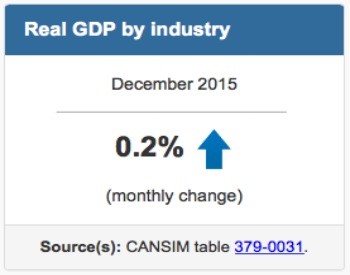
GDP Rises 0.2% in December
March 7 2016
Real gross domestic product grew 0.2% in December, after rising 0.3% in November. Manufacturing and wholesale trade increased in December, while retail trade, mining, quarrying and oil and gas extraction as well as utilities posted notable declines.
The output of service-producing industries rose 0.3%, mainly as a result of increases in wholesale trade, the finance and insurance sector and the public sector (education, health and public administration combined). The arts, entertainment and recreation sector as well as accommodation and food services also advanced. In contrast, retail trade declined notably.
The output of goods-producing industries increased 0.2% in December. Manufacturing, construction and, to a lesser extent, the agriculture and forestry sector all rose. Mining, quarrying and oil and gas extraction as well as utilities declined.
Looking at the year as a whole, the value added of service industries rose 1.9%. Finance and insurance (+4.5%) and the public sector (education, health and public administration combined) (+1.2%) were the largest contributors to growth in service-producing industries. The agriculture and forestry sector grew 4.4% while manufacturing edged up 0.1%. Notable declines occurred in mining, quarrying and oil and gas extraction (-3.5%), construction (-3.4%) and utilities (-1.0%). Goods-producing industries also decreased 1.6%, the first annual decline since 2009.
Chart 1 Real gross domestic product grows in December

Manufacturing output rises again
Manufacturing output rose 1.1% in December, following a 0.3% increase in November.
Chart 2: Manufacturing output rises in December

After growing 0.6% in November, durable-goods manufacturing expanded 1.0% in December. Notable gains were recorded in wood products, transportation equipment and miscellaneous manufacturing in December. Conversely, the manufacturing of fabricated metal products and, to a lesser extent, machinery declined.
Non-durable goods manufacturing grew 1.1% in December, mainly as a result of gains in petroleum and coal products manufacturing and chemical manufacturing. In contrast, food manufacturing and, to a lesser extent, textile, clothing and leather manufacturing were down.
Wholesale trade expands while retail trade contracts
After rising 1.0% in November, wholesale trade expanded 1.8% in December, as most trade subgroups posted growth. Motor vehicle and parts wholesaling, and building materials and supplies wholesaling were major contributors to the growth in December. In contrast, miscellaneous wholesalers (including wholesalers of agricultural supplies) declined.
Retail trade contracted 1.8% in December on the weakness of almost all trade subgroups, following a 1.5% rise in November. Declines were notable at motor vehicle and parts dealers, clothing and clothing accessories stores, food and beverage stores as well as general merchandise stores in December. Conversely, furniture and home furnishings stores posted gains.
The finance and insurance sector advances
The finance and insurance sector advanced 0.9% in December. Banking, insurance services as well as financial investment services all increased.
Mining, quarrying, and oil and gas extraction falls
Mining, quarrying, and oil and gas extraction fell 0.7% in December, after rising 0.4% in November.
After rising 1.6% in November, oil and gas extraction fell 0.6% in December, as a result of a decline in natural gas extraction. Non-conventional oil extraction and conventional crude petroleum extraction were up in December.
Support activities for mining and oil and gas extraction contracted 7.4% in December, as a result of declines in both rigging and drilling services.
In contrast, mining and quarrying (excluding oil and gas extraction) rose 1.7% in December, mainly as a result of increases in metal ore and coal mining. Potash mining was down in December.
Utilities contract
Utilities contracted 2.6% in December as a result of decreases in both electricity generation, transmission and distribution and natural gas distribution. Unseasonably warm weather in many parts of the country resulted in lower demand for electricity and natural gas in December.
Construction increases
Construction increased 0.6% in December. Engineering construction, residential building construction and repair construction were up. In contrast, non-residential building construction was down.
The output of real estate agents and brokers rose 0.4% in December, a third consecutive monthly gain.
The public sector grows
The public sector (education, health and public administration combined) grew 0.2% in December. Public administration, health care services as well as educational services were up.
Other industries
The arts, entertainment and recreation sector increased 2.1% in December, as a result of gains in spectator sports and related industries. Accommodation and food services were up 0.8% in December.
Chart 3: Main industrial sectors’ contribution to the percent change in gross domestic product in December

Fourth quarter of 2015
The value added of service industries rose 0.5% in the fourth quarter, while that of goods-producing industries declined 0.9%.
The public sector (education, health and public administration combined) and wholesale trade were the main contributors to the growth in the fourth quarter. There were also gains in the agriculture and forestry sector, retail trade, transportation and warehousing, as well as the finance and insurance sector. In contrast, mining, quarrying and oil and gas extraction, construction, manufacturing and utilities declined.
Annual 2015
The value added of service industries rose 1.9% in 2015. The value added of goods-producing industries, however, decreased 1.6%, the first annual decline since 2009.
There were notable declines in mining, quarrying and oil and gas extraction (-3.5%), construction (-3.4%) and utilities (-1.0%). The agriculture and forestry sector grew 4.4% while manufacturing edged up 0.1%.
Finance and insurance (+4.5%) and the public sector (education, health and public administration combined) (+1.2%) were the largest contributors to growth in service-producing industries in 2015. There were also notable gains in transportation and warehousing services (+3.1%), retail trade (+2.4%) and wholesale trade (+1.3%).
Source: Statistics Canada, www.statcan.gc.ca/daily-quotidien/160301/dq160301b-eng.htm?HPA.