ABB Technology Helps Monitor Key Atmospheric Changes from Space
June 28, 2019
For decades, ABB has made intricate scientific instruments that measure and analyze gases in the atmosphere to help scientists better understand its composition and evolution. Now, ABB is helping to more accurately measure greenhouse gases (GHGs), which are trapping heat in the atmosphere, resulting in an increase in global surface temperature.
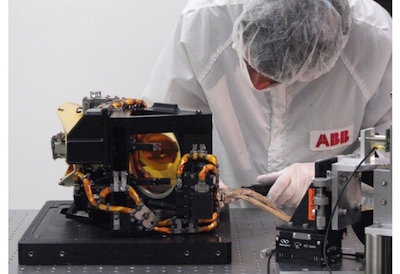
One such instrument is an ABB interferometer carried aboard the Greenhouse Gases Observing Satellite-2 (GOSAT-2), which was launched in October 2018 as part of a Japanese government project. Interferometers like the one on GOSAT-2 measure and analyze the amount of energy at numerous points throughout the optical spectrum (about 10,000 different colours are distinguishable on GOSAT-2). More importantly, these instruments can track molecular “fingerprints” left on a reflected or transmitted light beam. Using this technique, called absorption spectroscopy, emissions from industrial sources can be monitored and quantified accurately even from high in space.
“This technology can be designed for a myriad of applications, from reading crop health in agriculture, to forecasting weather, spotting polluters, and searching for planets outside the solar system that may harbour life,” says Frederic Grandmont, Technology & Business Development Manager, Space & Defense Systems, at ABB Quebec, where the interferometer was developed.
“The ultimate goal of the GOSAT mission is to confirm our understanding of greenhouse gases,” Grandmont adds. “We want to know where they are being emitted, where they are being absorbed and how the weather patterns move these masses around the globe.”
The GOSAT-2 satellite orbits the earth 15 times a day, at an altitude of 613 kilometres, using the ABB interferometer to help make more than 100,000 precise measurements of carbon dioxide, methane, ozone, water vapour, carbon monoxide and nitrogen dioxide in the earth’s atmosphere.
The atmospheric data collected by the instrument in orbit are transferred to the National Institute for Environmental Study (NIES), Japan. The NIES team then archives and processes the data into comprehensive maps that show GHG concentration in both hemispheres. One of the striking observations from orbit is to witness on a global scale how the plant growth seasons in the spring manage to remove most of the GHGs that have accumulated over the winter. The massive injection of GHGs from densely industrialized areas can also be seen from orbit.
The GOSAT-2 greenhouse gas sensor readings are now being validated by the NIES team, cross-checking data from the satellite with measurements by instruments on the ground, in aircraft or balloons to confirm its high accuracy.
The measurements from GOSAT-2 provide important data that contribute to a better understanding of climate science and are therefore a more effective input to the formulation of international emissions reduction policies. The Intergovernmental Panel on Climate Change (IPPCC), a body of the United Nations aimed at reporting on the state of the GHG problems, makes extensive use of the GOSAT data as a basis of discussion for negotiating international treaties on emissions reduction.
Continuous measurement of GHGs is necessary to better quantify how the earth uptakes and stores them in grasses, crops and trees. If scientists understand these biological mechanisms better, they can work on improved methods of mitigating carbon emissions. Continuous measurement of emissions is also needed at various scales (country, cities, industries) to enable the enforcement of cap & trade measures in competitive environments.
This article was first published online by ABB.