Mohawk College IDEAWORKS Provides Critical Role for Industry and Education
Nov 1, 2019
By Blake Marchand
When it comes to bringing technology and innovation into the marketplace, in particular, technologies and innovations that broader society has vested interest in proliferating, collaboration between government, educational institutions, and industry are often a necessity. While colleges and universities excel in research and development from an intellectual and facility perspective, they aren’t as equipped as industry when it comes to bringing those innovations to market. And from a resource perspective, government can bridge the gap between industry and institution to provide an extra incentive to not only innovate but bring those innovations to fruition in the marketplace.
This is why programs like Mohawk College’s IDEAWORKS and their Energy and Power Innovation Centre (EPIC) are so crucial to the industry as well as in developing well-rounded students that are prepared to succeed within that industry.
“Mohawk College has conducted applied research for approximately 12 years and focusing energy and power for 9 years, the initial area of expertise of EPIC was protection and control, and power quality. For the last two years, we have re-focused our areas to evolve with industry, as well as involve more our students and Faculty,” explained EPIC General Manager, Mariano Arriaga. Operating on a cost-recovery basis, the Centre has been able to develop and grow with provincial and federal government grants, as well as with their collaboration with industry stakeholders.
IDEAWORKS engages undergraduate students and hires co-op students in Mohawk’s Energy and Electrical programs, which in addition to providing practical research and development experience, provides students with career opportunities with the companies the college is collaborating with. A benefit to the industry and students.
 “We provide them with a meaningful experiential learning opportunity since they are working directly with industry in solving some of the current problems. The students participate directly in projects ranging from testing, validation, and demonstration of new technologies; verify performance and efficiency of technologies and different configurations, as well as feasibility studies. In addition, from an industry perspective, our projects involving students become a pre-interview process for industry to hire students that, as part of the projects, are already familiar with their products and services,” said Mariano.
The Centre essentially lowers the risk companies undertake when developing new products or technologies. Maximizing value proposition by leveraging government funding, providing targeted training activities, and ultimately providing access to facilities and equipment, “including electrical testing and monitoring, protection and control equipment, power sources (conventional and renewable), real-time simulator, and battery and solar PV emulator. As well as, information from the College’s Building Automation System (BAS) for a recently opened 8, 900m2 Net-Zero Energy Building.”
Mariano said the Centre has established a process to identify and work with industry partners in applied research projects. Guiding them to the process of identifying the challenge, scoping the project, finding funding sources, and developing the collaboration project. In addition, EPIC has the support from IDEAWORKS Business Development team which helps identify potential partners and disseminate project results.
Mariano identified energy efficient technologies and cybersecurity as two areas pertinent to the future of the industry that EPIC has begun exploring.
“There is a set of energy efficiency measures that industry is and will implement without requiring an applied research component,” he explained, “We believe, and know, that industry can jump ahead and implement this right away. However, we want to focus on upcoming technologies, processes, sensors that require some testing, validation, and demonstration of the technology or configuration.”
“One of our main objectives, besides reducing energy consumption, is to decrease commissioning time at industrial facilities as much as possible.”
Mohawk recently opened a cybersecurity lab that will soon offer cybersecurity related programs.
“We want to leverage this upcoming expertise with the existing expertise in protection and control and our decommissioned substation facility in downtown Hamilton,” he said.
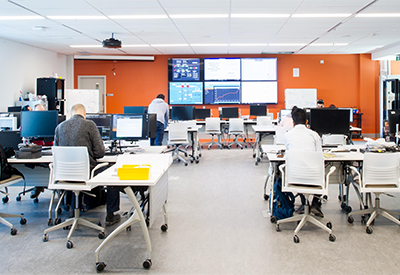
 In 2018, Alectra Utilities provided use of a decommission substation, with support from Omicron, Schweitzer Engineering Laboratories, Schneider Electric, and Siemens. The substation was renovated to include classrooms, and ultimately provide a real-life working environment for students, as well as a facility for the industry to conduct training, demonstration, testing and research.
Mariano has been EPIC’s General Manager since June 2019. He earned his B.A.Sc. and M.A.Sc. degrees in Industrial Systems Engineering from the University of Regina in 2002 and 2003, respectively.
“My experience has been very positive while growing the Centre and finding opportunities for our students, faculty, and technical staff to get involved in projects directly related to industry problems. The Applied Research capabilities of Mohawk (EPIC), and, I can say, Colleges in general, are growing areas where collaborative projects with industry can bring mutual benefits,” said Mariano of his time with EPIC.
Over the past 10 years Mariano has focused on renewable energy research and practical projects at different development stages, with a special focus on energy for remote communities. He also works with Ontario’s First Nations as an advisor and instructor in energy-related opportunities at the community level.
His work and research have taken him all over the world from his hometown in Mexico to Canada, Tanzania, and Laos. He earned a M.Sc. in Renewable Energy at the University of Zaragoza, Spain in 2009 and completed his Ph.D. in Electrical and Computer Engineering from the University of Waterloo in 2015.
Photos courtesy Mohawk College
Blake Marchand is Assistant Editor with Kerrwil Electrical Group