The Smart Grid Atlantic Project: Developing the Electrical Grid of the Future
PB 43 Siemens SmartGridAtlantic 400

March 25, 2021

Smart Grid Atlantic: a living lab

The Smart Grid Atlantic initiative will determine how energy technologies of the future can provide customer, community, and provincial benefits such as cleaner local power, more renewable energy, new energy solutions and more reliable electricity.

Creating Smart Energy Communities in Atlantic Canada

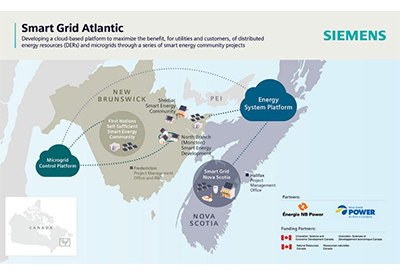
Announced in 2019, Siemens Canada, New Brunswick Power (NB Power) and Nova Scotia Power (NSP) received federal funding for a joint pilot project aimed at analyzing challenges and opportunities posed by Canada’s energy transition. The partners are researching and testing how the grid of the future can optimize the integration of renewable sources of energy, ensure the stability of the grid and manage decentralized distribution. The aim is to better manage the provinces’ electricity, potentially reduce consumers’ future electricity costs and reduce greenhouse gas emissions.

The Smart Grid Atlantic project deploys Siemens Energy System Platform (ESP) in both provinces (New Brunswick and Nova Scotia). The benefits of distributed energy resources (DERs) and entire microgrids for utilities and customers will be maximized through a series of smart energy community projects. A wide array of grid-edge devices and community and utility-scale assets will be connected. This includes: 

  •    –   Residential solar, storage, water heaters, heat pumps, etc.
  •    –   Fleet and residential electrical vehicle charging
  •    –   Building automation systems
  •    –   Commercial solar, storage and loads
  •    –   Community solar and utility-scale storage

This project is a living lab for utilities to understand how customers engage with new offerings. It is demonstrating how to design new business models, create value, and analyze how incentive structures can influence behaviour. With all stakeholders involved, it is providing a critical roadmap for an efficient and cost-effective energy transition, leading to a more resilient and sustainable future.

Go HERE to download a whitepaper on the project

Related Articles


Latest Articles

  • What 2025 Revealed About Canada’s Electrical Industry

    What 2025 Revealed About Canada’s Electrical Industry

    December 16, 2025 By Carol McGlogan, President & CEO, Electro-Federation Canada The past year required Canada’s electrical industry to adapt to a rapidly changing environment. In 2025, businesses across the value chain navigated shifting trade conditions, evolving policy landscapes, and growing expectations tied to electrification and infrastructure expansion. Trade uncertainty introduced new complexity. Organizations reassessed Read More…

  • Considerations for EV Charging Installation and Site Preparation

    Considerations for EV Charging Installation and Site Preparation

    December 15, 2025 By Blake Marchand As part of our recent discussion with LEDVANCE EVSE Product Manager, Erich Bockley, he emphasized the importance of site preparation Site preparation can be the most complicated part of the project, Bockley emphasized, a lot needs to be considered before the installation work begins. Many public charging applications will Read More…

  • Ontario’s Multi-Family Component Leads Residential Sector Increases in October Building Permits

    Ontario’s Multi-Family Component Leads Residential Sector Increases in October Building Permits

    December 15, 2025 In October, the total value of building permits issued in Canada rose $1.8 billion (+14.9%) to $13.8 billion. The increase in construction intentions was led by the residential sector (+$1.1 billion). An increase was also observed in the non-residential sector (+$702.8 million). On a constant dollar basis (2023=100), the total value of building permits issued in Read More…

  • Residential Investment in Building Construction Declines in September

    Residential Investment in Building Construction Declines in September

    December 15, 2025 Overall, investment in building construction decreased 1.1% to $22.4 billion in September. Investment in the residential sector declined 1.7%, while that in the non-residential sector was virtually unchanged. Year over year, investment in building construction grew 6.0% in September. On a constant dollar basis (2023=100), the total value of investment in building construction in September decreased 1.4% Read More…


Changing Scene