Building Permits, June 2025: Ontario’s Institutional Component Leads Decline After Rising Sharply in May
September 8, 2025
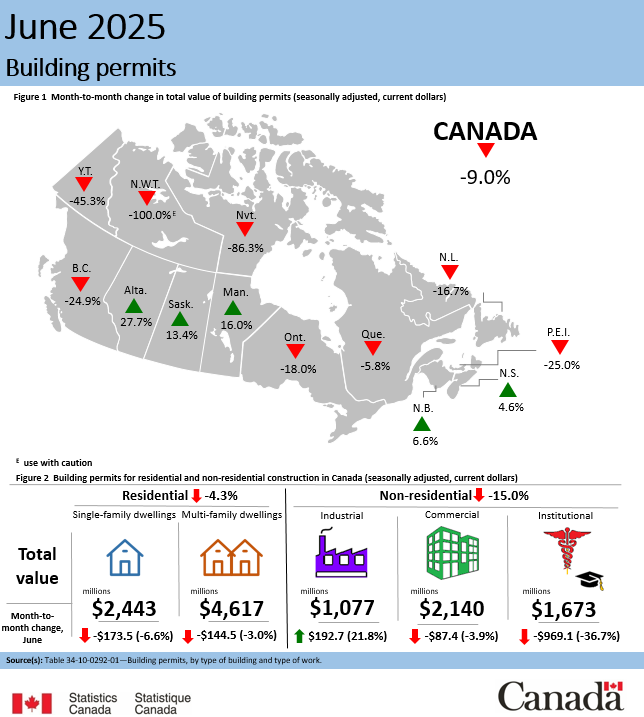
In June, the total value of building permits issued in Canada decreased by $1.2 billion (-9.0%) to $12.0 billion. Ontario’s institutional component (-$1.4 billion) led the decline in construction intentions in June, after driving the growth in May.
On a constant dollar basis (2023=100), the total value of building permits issued in June decreased 9.5% from the previous month and was up 6.9% on a year-over-year basis.
Ontario’s institutional component leads decline in June after rising sharply in May
The value of non-residential building permits decreased by $863.8 million to $4.9 billion in June.
Ontario’s institutional component receded from $1.9 billion in May to $538.0 million in June, driving the monthly non-residential sector decline. Despite this decrease, institutional construction intentions remained strong, at $1.7 billion at the national level. Overall, the institutional component was bolstered by growth in Alberta (+$455.4 million), which was driven by hospital construction intentions in the Red Deer census metropolitan area (CMA).
Commercial construction intentions declined by $87.4 million in June, led by Quebec (-$113.6 million), British Columbia (-$38.9 million) and Nova Scotia (-$33.9 million). Ontario (+$139.6 million) partially offset the declines with new permits for warehouses, indoor recreational facilities and retail and wholesale outlets.
The industrial component increased by $192.7 million in June, led by Quebec (+$136.4 million) and Ontario (+$78.1 million).
British Columbia’s multi-family component leads residential sector decline
Residential construction intentions decreased by $318.0 million to $7.1 billion in June. British Columbia’s multi-family component (-$486.8 million) led the decline after leading the sector gains in May.
In June, British Columbia’s multi-family component drove the decline in the multi-family component at the national level, which receded by $144.5 million to $4.6 billion, while Ontario (+$261.1 million) tempered losses.
In June, the single-family component declined by $173.5 million to $2.4 billion, driven by Ontario (-$91.1 million) and followed by Alberta (-$36.9 million).
Quarterly review: residential construction intentions lead quarterly decline
The total value of building permits in the second quarter was down $1.9 billion to $36.7 billion, following five consecutive quarterly increases. The residential sector (-$3.8 billion) drove the decrease, while Ontario’s non-residential sector (+$2.5 billion) tempered losses in the second quarter.
Residential construction intentions declined 15.0%, totalling $21.7 billion in the second quarter. The multi-family component (-$3.0 billion) drove the decline, fuelled by losses in Ontario (-$1.6 billion) and British Columbia (-$1.3 billion). Ontario’s decrease was driven by the Toronto CMA (-$1.4 billion), which experienced a second consecutive quarterly decline. The Toronto CMA recorded its lowest constant dollar value since the series started in 2018, despite having significantly contributed to the growth in the fourth quarter of 2024. The Vancouver CMA (-$1.2 billion) drove the decline in British Columbia in the second quarter of 2025, after leading growth in the national multi-family component in the first quarter.
In the second quarter, the single-family component decreased by $874.3 million to $7.7 billion, led by Ontario (-$645.1 million) and supported by Alberta (-$207.1 million).
A total of 305,400 single-family and multi-family units were authorized for construction from the third quarter of 2024 to the second quarter of 2025, an increase of 37,900 units (+14.2%) compared with the 267,500 units authorized over the same period one year earlier.
Non-residential construction intentions increased by $2.0 billion to a record high of $15.0 billion in the second quarter. This increase was driven by Ontario, largely due to its institutional component (+$1.4 billion).
Ontario, with the support of Alberta (+$463.8 million), drove the national institutional component to a quarterly series high of $5.6 billion. Hospital construction intentions in the St. Catharines–Niagara CMA and the Red Deer CMA drove the increase in each province, respectively.
The industrial component increased $698.9 million to $2.9 billion in the second quarter, led by Ontario (+$708.7 million) and Quebec (+$166.8 million).
Meanwhile, the commercial component declined by $147.3 million to $6.5 billion. Decreases were recorded primarily in British Columbia (-$519.2 million) and, to a lesser extent, Alberta (-$130.9 million) and New Brunswick (-$119.8 million). These declines were tempered by a gain in Ontario (+$406.2 million).