BC Non-Residential Drives Growth, Multi-Family Component Drives Residential Decline in February Building Permits
April 18, 2025

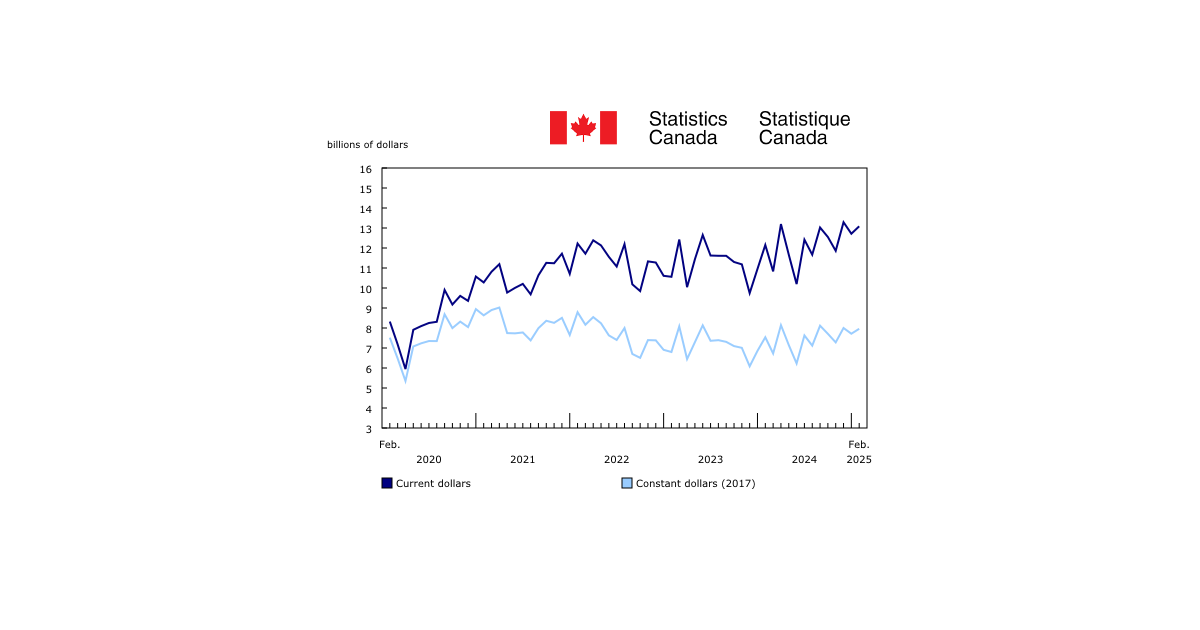
In February, the total value of building permits issued in Canada increased by $371.3 million (+2.9%) to $13.1 billion. Gains in construction intentions were led by British Columbia’s non-residential sector.

On a constant dollar basis (2017=100), the total value of building permits issued in February grew 3.2% from the previous month and was up 5.6% on a year-over-year basis.

British Columbia’s construction intentions lead the growth in the non-residential sector

The national value of non-residential building permits increased by $618.7 million (+15.3%) to $4.7 billion in February, rebounding after four consecutive months of declines. British Columbia’s non-residential sector (+$657.7 million) led the growth, supported by gains in the commercial (+$390.0 million) and institutional (+$248.8 million) components. Major projects in the Vancouver census metropolitan area (CMA) significantly contributed to gains for the province’s commercial and institutional components.

The growth in Canada’s non-residential sector was spread across its three components in February, with gains in the commercial (+$481.8 million), industrial (+$86.2 million) and institutional (+$50.7 million) subsectors. The industrial component ticked up in February 2025, after trending downward since September 2024. In the summer of 2024, the industrial component drove the non-residential sector to a quarterly series high in the third quarter of the year.

British Columbia’s multi-family component drives the residential sector decline

Canada’s residential construction intentions declined by $247.4 million (-2.9%) to $8.4 billion in February 2025. Overall, the multi-family component fell by $224.8 million, while the single-family component decreased by $22.6 million.

British Columbia’s multi-family component (-$185.5 million) led the decline, with decreases concentrated in the Vancouver CMA. Quebec (-$131.5 million) and New Brunswick (-$105.4 million) contributed to the residential sector decrease in February, after helping to offset losses in the national residential sector the previous month. Quebec’s residential sector decline was driven by the multi-family component (-$107.9 million) and supported by the single-family component (-$23.6 million). New Brunswick’s residential sector decrease was led by the multi-family component (-$103.3 million). The decrease in the national residential sector was mitigated by Ontario (+$110.2 million).

Across Canada, 21,000 multi-family dwellings and 4,800 single-family dwellings were authorized in February, down 7.1% from the previous month.

Go HERE for more information

Related Articles


Latest Articles

  • Mastering Advanced Bidding Strategies in Electrical Contracting

    Mastering Advanced Bidding Strategies in Electrical Contracting

    December 1, 2025 By Melvin Newman, Patabid CEO & Ian Paterson, Patabid Client Success Manager and journeyman electrician with 30+ years of experience In the competitive world of electrical contracting, knowing how to estimate electrical jobs effectively can make the difference between winning profitable projects and watching opportunities slip away. For electrical contractors, mastering advanced… Read More…

  • Why Choosing the Right USB Charger Matters

    Why Choosing the Right USB Charger Matters

    December 1, 2025 Not all USB Chargers are Created Equal As the number of devices used daily increases, so does the need for a charger that delivers safe speeds and maximum charging potential. A high-quality USB charger delivers efficient charging without risk of damage, but the sea of USB chargers and outlets available on online… Read More…

  • How Homebuilding Incentives Can Pay Off for Cities, Homeowners and Local Economies: New Concordia Study

    December 1, 2025 A new study from Concordia University’s John Molson School of Business finds that improving housing affordability isn’t just a social good — it’s an economic growth opportunity. Build and Benefit: How Homebuilding Incentives Can Pay Off for Cities, Homeowners and Local Economies reframes housing policy reform as a sustainable fiscal growth strategy, demonstrating meaningful… Read More…

  • The Importance of HazLoc LED Lighting for Safe Workplaces

    The Importance of HazLoc LED Lighting for Safe Workplaces

    November 30, 2025 By CSC LED In Canada’s industrial lighting sector, one of the most critical yet often overlooked safety components is lighting designed specifically for hazardous locations, otherwise known as HazLoc (hazardous location) LED lighting. For workplaces dealing with flammable gases, vapours, combustible dust, or ignitable fibres, standard LED fixtures simply don’t cut it…. Read More…


Changing Scene

  • Skills Ontario Celebrates the Expansion of Trades & Tech Truck Program

    Skills Ontario Celebrates the Expansion of Trades & Tech Truck Program

    December 1, 2025 Skills Ontario is expanding its fleet of Trades & Tech mobile unit thanks to support from the Ontario Government. The government announced this morning it’s investment in Skills Ontario to expand experiential opportunities for Ontario’s future workforce.    “Ontario’s future relies on a strong, skilled workforce,” said David Piccini, Minister of Labour, Immigration,… Read More…

  • BC’s Canadian Mutual Recognition Agreement aims to Facilitate Interprovincial Trade

    BC’s Canadian Mutual Recognition Agreement aims to Facilitate Interprovincial Trade

    December 1, 2025 A new agreement signed by all provinces, territories, and the federal government will break down interprovincial trade barriers, making it easier for B.C. businesses to sell products across Canada, and for people to buy Canadian-made goods.   “When threats to Canada’s economic security land at our doorstep, we’re at our best when we work together as… Read More…

  • EB Horsman’s Commitment to Giving Back – A Year in Recap 2024/2025

    EB Horsman’s Commitment to Giving Back – A Year in Recap 2024/2025

    December 1, 2025 EB Horsman Cares is the company’s community engagement program that supports local children’s hospitals, communities, and non-profit initiatives with donations, fundraising, volunteering, and scholarships.  Since 1993, BC Children’s Hospital has been the primary recipient of EB Horsman & Son’s fundraising. However, as EB Horsman has continued to expand its businesses across Western… Read More…

  • Build Canada Homes Introduces Policy Framework to Guide its Investments in Affordable Housing

    Build Canada Homes Introduces Policy Framework to Guide its Investments in Affordable Housing

    December 1, 2025 Central to that work, the Government of Canada is stepping up with the recently launched Build Canada Homes, new federal agency with a mandate to scale up the supply of affordable housing across Canada. Build Canada Homes will also help fight homelessness by building transitional and supportive housing – working with provinces,… Read More…