Non-Residential Building Investment Increases Slightly in August, 2025
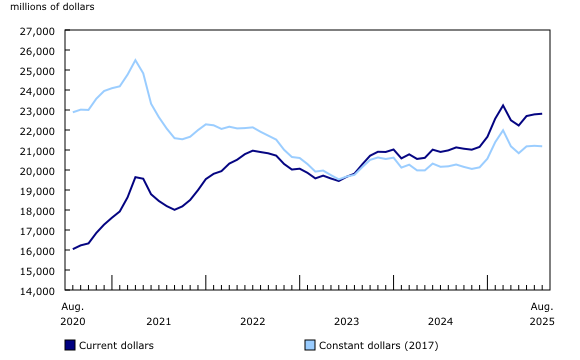
Overall, the total value of investment in building construction edged up 0.1% to $22.8 billion in August. The non-residential sector edged up $22.9 million, while the residential sector increased slightly by $10.5 million. Year over year, investment in building construction grew 8.7% in August.
On a constant dollar basis (2023=100), the total value of investment in building construction in August edged down 0.1% from the previous month to $21.2 billion and was up 5.0% year over year.
Non-residential building investment increases slightly in August
In August, the value of non-residential investment in building construction increased $22.9 million to $6.8 billion. Investment in the commercial and institutional sectors each grew 0.8% during this period, while the industrial component was down 1.4%.
Investment in the commercial component rose $25.3 million to $3.3 billion in August. This growth was primarily driven by gains in Ontario (+$26.9 million).
Investment in the institutional component edged up $16.7 million to $2.1 billion in August. Gains were led by Alberta (+$15.1 million).
Meanwhile, investment in the industrial component declined $19.0 million to $1.3 billion in August. Overall, six provinces and two territories contributed to the decrease, led by Quebec (-$8.7 million) and followed by British Columbia (-$6.3 million) and Alberta (-$4.7 million).
Residential construction investment edges up, led by single-family homes
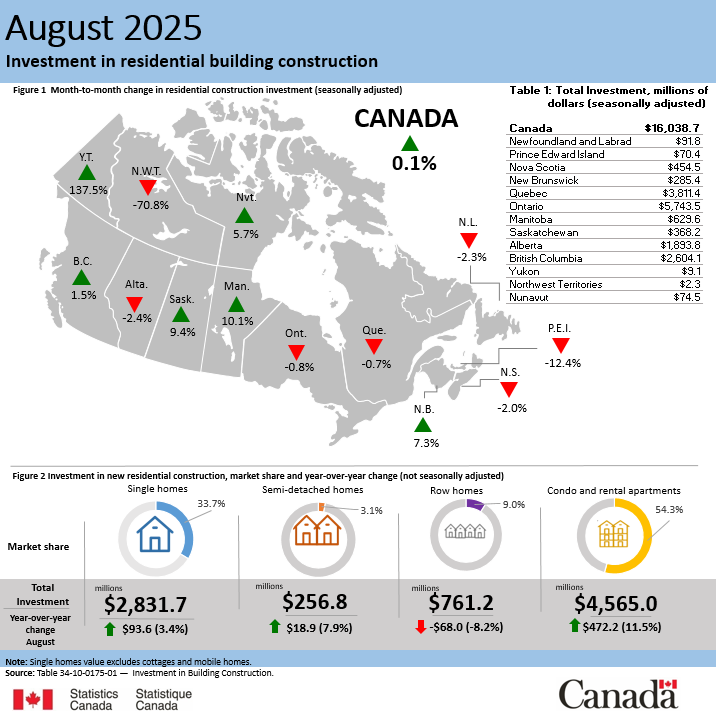
Residential investment in building construction edged up $10.5 million to $16.0 billion in August. This growth was primarily driven by the single-family component (+2.8%), while the multi-unit component (-2.2%) experienced a decline.
Investment in single-family home construction rose $202.1 million to $7.4 billion in August. Gains were recorded in seven provinces and two territories, led by Ontario (+$65.4 million) and followed by New Brunswick (+$28.0 million) and Saskatchewan (+$27.8 million).
Meanwhile, investment in multi-unit construction decreased $191.6 million to $8.7 billion in August. The decline in the multi-unit component was primarily driven by Ontario (-$111.5 million), followed by Alberta (-$54.8 million) and Quebec (-$53.2 million). Overall, five provinces and two territories contributed to the decrease in this component.
![Guide to the Canadian Electrical Code, Part 1[i], 26th Edition– A Road Map: Section 74 — Airport installations](https://electricalindustry.ca/wp-content/uploads/2026/05/EIN-Stock-Guide-Code-Canada-Map-1200-768x403.png)



![Guide to the Canadian Electrical Code, Part 1[i], 26th Edition– A Road Map: Section 74 — Airport installations](https://electricalindustry.ca/wp-content/uploads/2026/05/EIN-Stock-Guide-Code-Canada-Map-1200.png)