Inline Circulation Heaters Can Simplify Many Liquid Applications in Business
March 21 2016
Companies that rely on flowing liquids such as oils, water or natural gas often rely on overly-complicated systems to keep everything functioning properly. These companies don’t worry about the systems being too complex until something goes wrong. Then the issue is a big deal, but it’s often too late for the system to be modified, or the company is committed to their current solution. To help set up that simple setup originally, your company should consider relying on inline circulation heaters for oils, natural gas, water or any other solution that has to be kept at a constant temperature. The heaters are flexible and can heat liquids up to 1500 degrees Fahrenheit or much less depending on heating needs.
How inline circulation heaters work
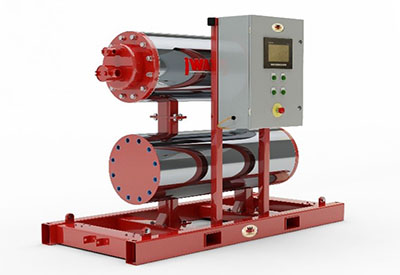
Inline circulation heaters are pretty simple in how they work. They have an inlet and an outlet that connects right up to your standard lines that the liquid is already flowing through. The liquid goes through the inlet, gets heated by the interior element, and then flows through the outlet back into the standard loop. These heaters typically come with insulation to help prevent heat loss, and some also come with filters to clean up the fluid flowing through and to protect the heat elements as well.
The heaters are designed with a thermostat so that you can adjust the final temperature of the fluid up or down until it’s exactly where you want it to be in the end.
Simple service and maintenance
When relying on an inline heater to warm liquids you won’t have to work nearly as hard to maintain the system and make sure that it functions properly. Often making a repair to the system is as simple as closing a valve and replacing a part on the heater or replacing the entire unit for a new one. There are less individual parts than there are in a tank heater, and the parts are typically more accessible as well.
Cut down on tank heat losses
If your application demands a nearly constant level of heat in oil, natural gas or water, you can rely on an inline circulation heater rather than a tank heater to achieve those temperatures more efficiently. When using a tank to keep constant temperatures, your system will suffer from more heat loss out the walls of the tank. When heating the system right in the line that needs the heat itself you’ll benefit from less heat loss overall and a more efficient system, not to mention that you’ll have one container less to maintain and replace when the time comes.
While it might not be worth the switch to move from a tank heater setup to an inline one if all your equipment is brand new, companies that are about to install new heaters, or a company that hasn’t yet put together a heated system should strongly consider using inline circulation heaters rather than tank-based systems. They are often more affordable and more efficient and they are certainly simpler and easier to maintain.
Ilan Toledano, is the President of Wattco. With over 20 years of experience in the electric heating industry, Ilan Toledano has been involved in sales and marketing, product development, and expansion of the industrial immersion heaters in the chemical and oil and gas industry for the past 15 years. Mr. Toledano has a B.Comm from Concordia University in Finance and Business Law; www.wattco.com