December 2015 Energy Use Down 6.8% YOY Due to Warmer Temperatures
March 2 2016

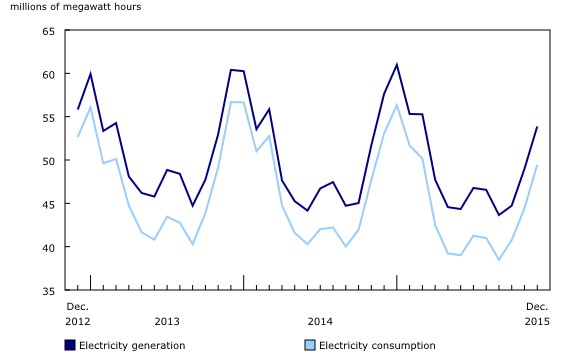
Canada’s demand for electricity totalled 49.5 million megawatt hours (MWh) in December, down 6.8% from the same month in 2014. Unseasonably warm weather in most of the country contributed to the decline in demand. Lower demand pushed generation down 6.5% to 53.9 million MWh, the lowest level for a month of December since 2003. Exports of electricity to the United States also declined year over year in December, falling 3.1% to 5.2 million MWh. This was the first year-over-year decrease in exports of electricity since October 2014.


Much of the decline in exports reflects lower shipments from Quebec and Ontario as eastern U.S. states reported their warmest December temperatures in recorded history, according to the National Centers for Environmental Information. Exports from British Columbia tempered the decline, rising 34.4%.

Meanwhile, imports from the United States also decreased in December, totalling 0.8 million MWh.

Demand for electricity in Quebec was down 11.0% to 18.5 million MWh, the lowest level for a month of December in 14 years. Warmer weather contributed to the decline, as the province has a high proportion of electric heating. Similarly, generation levels within the province decreased 10.2% to 17.7 million MWh.

Alberta and Ontario also contributed significantly to the decline in national demand. In Alberta, demand fell 9.4% to 5.5 million MWh, contributing to a 9.9% decline in generation. Demand for electricity in Ontario decreased 4.9% to 10.9 million MWh.

Canadian electricity generation and demand down in 2015

On an annual basis, Canada generated 592.8 million MWh of electricity in 2015, down 1.2% from 2014. Five of the eight generation sources recorded lower output in 2015. However, hydro, internal combustion and solar generating stations all posted gains.

Demand for electricity declined 3.5% to 534.2 million MWh in 2015. Canada delivered 67.1 million MWh of electricity to the United States, up 14.1% from the previous year, while imports fell by nearly a third to 8.7 million MWh.

Source: Statistics Canada, www.statcan.gc.ca/daily-quotidien/160226/dq160226a-eng.htm.


Related Articles


Latest Articles

  • What 2025 Revealed About Canada’s Electrical Industry

    What 2025 Revealed About Canada’s Electrical Industry

    December 16, 2025 By Carol McGlogan, President & CEO, Electro-Federation Canada The past year required Canada’s electrical industry to adapt to a rapidly changing environment. In 2025, businesses across the value chain navigated shifting trade conditions, evolving policy landscapes, and growing expectations tied to electrification and infrastructure expansion. Trade uncertainty introduced new complexity. Organizations reassessed Read More…

  • Considerations for EV Charging Installation and Site Preparation

    Considerations for EV Charging Installation and Site Preparation

    December 15, 2025 By Blake Marchand As part of our recent discussion with LEDVANCE EVSE Product Manager, Erich Bockley, he emphasized the importance of site preparation Site preparation can be the most complicated part of the project, Bockley emphasized, a lot needs to be considered before the installation work begins. Many public charging applications will Read More…

  • Ontario’s Multi-Family Component Leads Residential Sector Increases in October Building Permits

    Ontario’s Multi-Family Component Leads Residential Sector Increases in October Building Permits

    December 15, 2025 In October, the total value of building permits issued in Canada rose $1.8 billion (+14.9%) to $13.8 billion. The increase in construction intentions was led by the residential sector (+$1.1 billion). An increase was also observed in the non-residential sector (+$702.8 million). On a constant dollar basis (2023=100), the total value of building permits issued in Read More…

  • Residential Investment in Building Construction Declines in September

    Residential Investment in Building Construction Declines in September

    December 15, 2025 Overall, investment in building construction decreased 1.1% to $22.4 billion in September. Investment in the residential sector declined 1.7%, while that in the non-residential sector was virtually unchanged. Year over year, investment in building construction grew 6.0% in September. On a constant dollar basis (2023=100), the total value of investment in building construction in September decreased 1.4% Read More…


Changing Scene