The Wild and Wonderful of Thermal by FLIR – How Thermal Imaging is Augmenting More Than Just Cameras
May 5, 2025
By Krystie Johnston
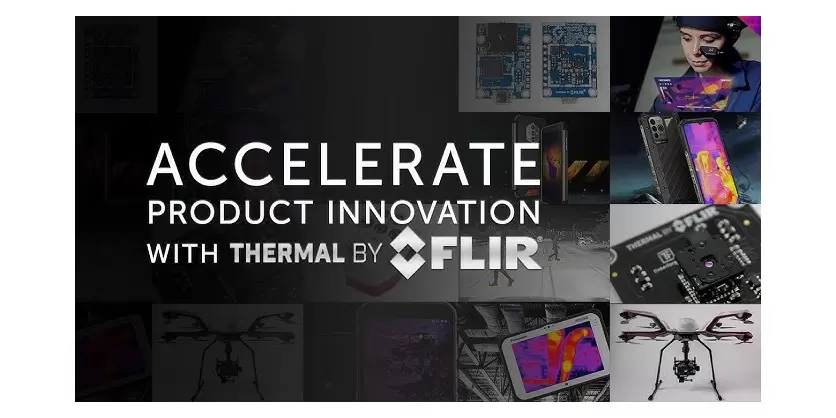
Teledyne FLIR OEM launched their Thermal by FLIR about six years ago, to expand support for original equipment manufacturers (OEMs) who integrate FLIR thermal camera technology into their products. Since then, these collaborations have taken thermal into completely new spaces. Mike Walters, Vice President of Emerging Product Management at FLIR says, “It feels like we are just at the beginning and there is this exciting whole new world of applications. Our customers frequently amaze us at how they want to apply Thermal.”
Walters works with emerging products at FLIR, where he helps OEMs use FLIR’s thermal technology in new applications or markets that have potential high growth. “I am responsible for our Thermal camera Lepton, which is integrated into rugged smartphones and many other applications. We also have been doing a lot of work in automotive safety, with improved automatic emergency braking and cameras designed specifically to be integrated in automobiles as standard equipment.”
This collaborative marketing with OEMs is mutually beneficial. Teledyne FLIR provides the latest and greatest thermal capabilities, and their customers share deep market knowledge of their application space. “We review the products and test the products that they have created and basically give it our stamp of approval that it is living up to the Teledyne FLIR brand. And then likewise, that really lets the equipment maker leverage the FLIR brand and use our ability to support and market the new product,” explains Walters.
For example, the integration of thermal imaging into a smart phone opened a new world of possibilities and ease of use for thermal imaging, says Walters. “It started out with the Cat family of rugged smartphones. And then most recently, about a month-and-a-half or so ago at Mobile World Congress, we introduced a new Sonim rugged smartphone with Thermal by FLIR and an integrated Lepton thermal camera.”
Walters explains that this development was especially useful to professionals who were already using FLIR’s handheld infrared cameras on job sites like construction and inspection. “It made their jobs so much easier. We basically brought together the advantages of a mobile phone that you always have with you and a thermal camera. So, if you are out working at job site, [and] you see a problem with the thermal camera, you can communicate it to your colleagues and get the problem diagnosed and fixed correctly.”
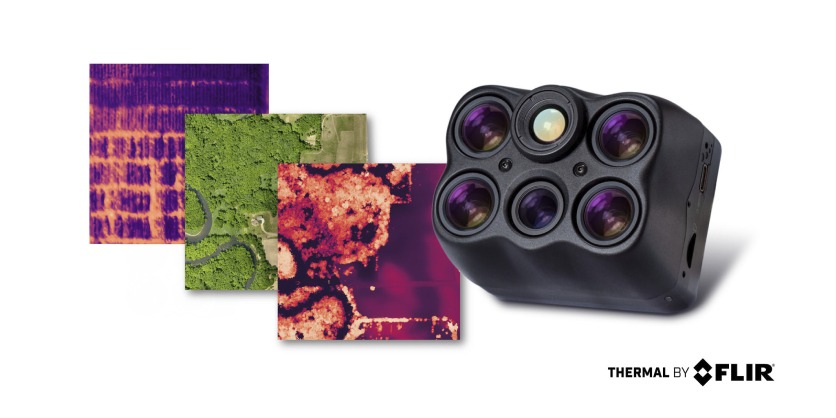
Equipping drones with thermal imagining is something FLIR does well – equipping their own drones and those of other drone vendors like the recent addition of Senra to the Thermal by FLIR program. “The drone space is very, very interesting. We have a lot of drone customers as well as having drones that we offer ourselves. And in that space, there are two or three major usages of thermal imaging. It can be used in search and rescue applications,” says Walters. “We can find somebody at night because the human body is like a thermal light bulb.”
Similarly, plants have heat signatures that enable experts to make predictions about crop productivity, water content, and plant health, explains Walters. “Thermal can also be used in payloads that are used in agricultural applications and perform a bit of aerial spectroscopy and take the information from the thermal spectrum and the visible spectrum and other things like near IR (infrared) and make some predictions.” Thermal imaging allows us to see things that are not visible to the naked eye and therefore augments everywhere you look.
Another application where Walters is seeing thermal imaging increasingly integrated is in the mobility space. He says that in recent years, there has been increasing use of thermal imaging to assist with automatic emergency braking systems. In the United States, for example, the National Highway Safety Transportation Administration introduced FMVSS No. 127, a new regulation that requires automakers to provide pedestrian automatic emergency braking that works up to about 40 miles per hour in real world conditions – day and night. For these tests, Teledyne FLIR’s thermal imaging shines new light.
“If these systems detect something like a pedestrian or a bicyclist in front of the vehicle, they basically take over and apply the brakes. You may see ads that show how these systems work in the daytime. But now [they are] applying them in the nighttime, where about 3/4 of the actual pedestrian or vulnerable road users’ fatalities happen.” In addition to advanced driver-assistance systems (ADAS) like the braking example above, Thermal is also being used to improve night vision and driver’s vision enhancement and in car design validation, production, and repair diagnostics.
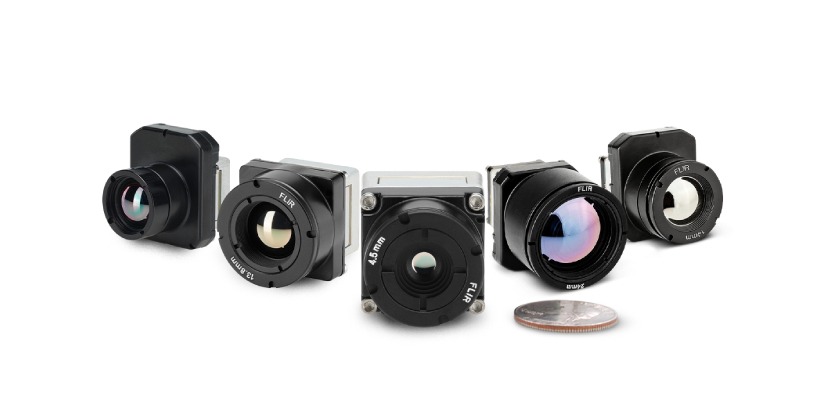
The robotic space is also seeing thermal being used more frequently in several applications. Autonomous vehicle manufacturers are approaching Teledyne FLIR to help them augment their equipment. “It is more than just applying the brakes; it is literally part of their machine learning and navigation capability. But robotics goes way beyond drones, or traditional vehicles. There is an amazing amount of emerging robotics applications in factories, and it can be allowing large, automated pallets, or forklifts, to move around the factory safely in the presence of people. And then there is a super exciting area of humanoid robots that may be working alongside people and factories.”
Thermal augments human vision and the vision of devices too, presenting innumerable future applications for man and machine alike. Collaborating with Teledyne FLIR to integrate thermal will not be an overnight journey, but one that is worth taking for some. Walters says it usually starts with a conversation to see where both sides are at, and what the road ahead looks like. “It is a journey. There are the initial discussions and the glance down the road to see if this makes sense. And then if it makes sense, we start walking that route together.”
Thermal by FLIR works with Canadian companies as well to integrate thermal imaging into processes and products north of the border. Walters recalls a Canadian company that wanted to use thermal for a lockout system in a factory. “If you are going to perform maintenance on an electrical aspect of some factory equipment, typically, the maintenance professional has a key that they insert and cut off the power. To restart the power, you must use that key to turn it back on,” explains Walters. “They wanted to incorporate thermal cameras into safety boxes to look for heating that might indicate a pending failure.”
There are many more applications where thermal is being integrated into products and processes to augment what is possible. Walters, a fourteen-year veteran of FLIR, says he would never have thought of having a thermal camera always with you on your phone. He can imagine in another fourteen years that personal devices will exist with advanced thermography and other sensors that enable us to do visual health checks akin to advanced imaging today. “I could probably go on for a long time about the exciting potential applications. We are just at the beginning.”