Wieland Compact DIN Rail Power Supply Modules
August 11, 2016

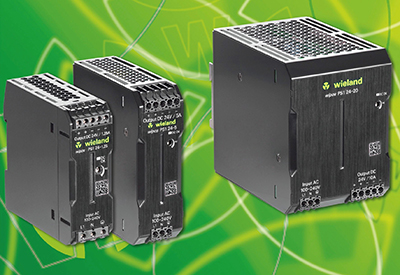
Wieland Electric Inc. has expanded its wipos series of DIN rail power supply modules with a new compact design for control cabinet applications. The new wipos PS series power supplies carry worldwide agency approvals, including UL, CSA, CE, as well as approvals for hazardous locations (Class 1, Div. 2) and shipboard installations (Lloyd’s Register).

The wipos PS1 Series power supplies are rated for 24VDC/1.25A to 20A output power, with capability for 120% power boost for 10 seconds. The modules accept a wide range of input voltages (85 – 264VAC/90 – 350VDC) for worldwide use, and feature power factor correction on modules rated ≥5A. Available in five module sizes, ranging from 32mm x 90mm x 90mm (1.25A) to 95mm x 125mm x 150mm (20A), the power supplies can be connected in parallel or in series, and are rated for operation between -40°C and +70°C (with 100% power at 60°C).

The wipos PS3 Series power supplies are rated for 24VDC/5A to 40A output power, with capability for 120% power boost for 10 seconds, and accept a wide range of input voltages (320 – 576VAC/450 – 810VDC) for worldwide use. Available in four module sizes, ranging from 40mm x 125mm x 122.2mm (5A) to 135mm x 125mm x 180mm (40A), the PS3 Series power supplies are rated for operation between -40°C and +70°C (with 100% power at 60°C). The PS3 supplies can also be powered using only 2 phases and still deliver 100% of their power ratings.

“The new wipos Series power supplies provide design engineers with the proven performance of Wieland’s rugged DIN rail power supply modules in a slim, compact housing,” says Martin Lalonde, Applications Engineer at Wieland Electric. “Rated for Class 1/Div. 2 harsh environments, as well as shipboard installations, the wipos PS1 and PS3 Series power supplies are ideal for a range of challenging applications.”

Wieland’s wipos Series power supply modules feature compensation for voltage drops through the adjustable output voltage.

Find out more: www.wieland-electric.ca/en-ca/products/electronics-control-cabinet.

 

Related Articles


Latest Articles

  • What 2025 Revealed About Canada’s Electrical Industry

    What 2025 Revealed About Canada’s Electrical Industry

    December 16, 2025 By Carol McGlogan, President & CEO, Electro-Federation Canada The past year required Canada’s electrical industry to adapt to a rapidly changing environment. In 2025, businesses across the value chain navigated shifting trade conditions, evolving policy landscapes, and growing expectations tied to electrification and infrastructure expansion. Trade uncertainty introduced new complexity. Organizations reassessed… Read More…

  • Considerations for EV Charging Installation and Site Preparation

    Considerations for EV Charging Installation and Site Preparation

    December 15, 2025 By Blake Marchand As part of our recent discussion with LEDVANCE EVSE Product Manager, Erich Bockley, he emphasized the importance of site preparation Site preparation can be the most complicated part of the project, Bockley emphasized, a lot needs to be considered before the installation work begins. Many public charging applications will… Read More…

  • Ontario’s Multi-Family Component Leads Residential Sector Increases in October Building Permits

    Ontario’s Multi-Family Component Leads Residential Sector Increases in October Building Permits

    December 15, 2025 In October, the total value of building permits issued in Canada rose $1.8 billion (+14.9%) to $13.8 billion. The increase in construction intentions was led by the residential sector (+$1.1 billion). An increase was also observed in the non-residential sector (+$702.8 million). On a constant dollar basis (2023=100), the total value of building permits issued in… Read More…

  • Residential Investment in Building Construction Declines in September

    Residential Investment in Building Construction Declines in September

    December 15, 2025 Overall, investment in building construction decreased 1.1% to $22.4 billion in September. Investment in the residential sector declined 1.7%, while that in the non-residential sector was virtually unchanged. Year over year, investment in building construction grew 6.0% in September. On a constant dollar basis (2023=100), the total value of investment in building construction in September decreased 1.4%… Read More…


Changing Scene