GEN2 650V SiC Schottky Diodes Offer Improved Efficiency, Reliability and Thermal Management
Feb 15, 2019
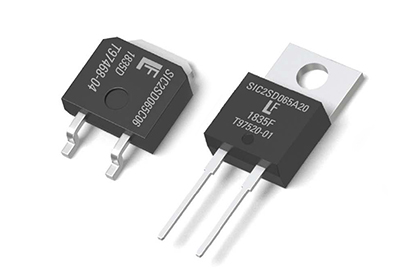
Littelfuse, Inc. has introduced two second-generation series of 650V, AEC-Q101-qualified silicon carbide (SiC) Schottky Diodes. The LSIC2SD065CxxA and LSIC2SD065AxxA Series SiC Schottky Diodes are available with a choice of current ratings (6A, 8A, 10A, 16A or 20A). They offer power electronics system designers a variety of performance advantages, including negligible reverse recovery current, high surge capability, and a maximum operating junction temperature of 175°C, so they are ideal for applications that require enhanced efficiency, reliability, and thermal management.
When compared to standard silicon PN-junction diodes, the 650V Series SiC Schottky Diodes support dramatic reductions in switching losses and substantial increases in the efficiency and robustness of a power electronics system. Because they dissipate less energy and can operate at higher junction temperatures than Si-based solutions, they allow for smaller heat sinks and a smaller system footprint. This provides end-users with all the advantages of more compact, energy-efficient systems and the potential for a lower total cost of ownership.
Typical applications for 650V Series SiC Schottky Diodes include:
- power factor correction (PFC),
- buck/boost stages in DC-DC converters,
- free-wheeling diodes in inverter stages,
- high-frequency output rectification and
- electric vehicle (EV) applications.
“These new series are our first 650V SiC Schottky Diode offerings; all our previous releases were 1200V-rated devices, so we can now address a wider range of applications and further complement the Littelfuse SiC MOSFET portfolio,” said Christophe Warin, Silicon Carbide Product Marketing Manager, Semiconductor Business Unit at Littelfuse. “Their AEC-Q101 qualification puts these diodes in a higher class than similar devices in terms of quality and reliability.”
The 650V Series SiC Schottky Diodes offer these key benefits:
- AEC-Q101-qualified diodes exhibit exceptional performance in demanding applications.
- Far lower switching losses than silicon bipolar diodes and fast, temperature-independent switching behavior make these devices suitable for high-frequency power switching.
- The positive temperature coefficient enables safe operation and ease of paralleling.
- The 175°C maximum operating junction temperature provides a larger design margin and relaxed thermal management requirements.
Go HERE for more information