Stelpro Invests $750,000 to Automate Baseboard Production
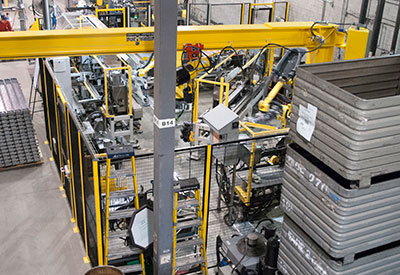
Stelpro Baseboard Production

Jan 22 2016

Stelpro, a Quebec manufacturer of integrated heating solutions, is investing $750,000 to automate and increase the productivity of its baseboard manufacturing at its plant in Saint-Bruno-de-Montarville. The investment will also reduce production costs and increase the company’s competitiveness.

“Of all the methods we have used to remain competitive, the robotization and automation of our manufacturing processes have taken on greater and greater importance in our business strategy,” says François Séguin, Vice-President of Operations. “Our plant is operating at full capacity, we are manufacturing over 800,000 units annually in St-Bruno and improving productivity is not just an option, it’s a must. The falling Canadian dollar is yet another reason for us to react quickly in order to remain competitive and maintain acceptable margins.”

After enhancing employee expertise through training programs for both employees and managers, and investing in continuous improvement, the time had come for Stelpro to equip itself with more efficient machinery that uses the latest technology and creates a safer work environment by automating hazardous tasks.

“Our employees are the key to our success and for us, automating manufacturing procedures is not synonymous with cutting jobs. Quite the opposite,” says Séguin. “Thanks to the savings resulting from increased productivity, we’ll be able to keep current jobs, as certain employees will be reassigned to other duties within the plant. In the medium-term, robotization may even create more specialized jobs, such as programmer, automation engineer, etc.).”

With this investment, Stelpro will be able to increase its productivity even more, which has risen by an average of 5% per year since 2010, thanks to an increase in production volume employee for employee. The new equipment is already functional and installation will be completed by the end of January.


Related Articles


Latest Articles

  • Capital Constraints in Owner-Operated Trade Businesses – When Owning the Building Quietly Limits Growth 

    Capital Constraints in Owner-Operated Trade Businesses – When Owning the Building Quietly Limits Growth 

    For many contractor-owned businesses, growth starts to feel harder than it should. The work is there. Customers are steady. Crews are busy. Yet when owners look to expand, invest, or create breathing room, capital often feels tighter than expected. In many cases, the issue is not operations or demand. It is a real estate decision made years… Read More…

  • What 2025 Revealed About Canada’s Electrical Industry

    What 2025 Revealed About Canada’s Electrical Industry

    December 16, 2025 By Carol McGlogan, President & CEO, Electro-Federation Canada The past year required Canada’s electrical industry to adapt to a rapidly changing environment. In 2025, businesses across the value chain navigated shifting trade conditions, evolving policy landscapes, and growing expectations tied to electrification and infrastructure expansion. Trade uncertainty introduced new complexity. Organizations reassessed Read More…

  • Considerations for EV Charging Installation and Site Preparation

    Considerations for EV Charging Installation and Site Preparation

    December 15, 2025 By Blake Marchand As part of our recent discussion with LEDVANCE EVSE Product Manager, Erich Bockley, he emphasized the importance of site preparation Site preparation can be the most complicated part of the project, Bockley emphasized, a lot needs to be considered before the installation work begins. Many public charging applications will Read More…

  • Ontario’s Multi-Family Component Leads Residential Sector Increases in October Building Permits

    Ontario’s Multi-Family Component Leads Residential Sector Increases in October Building Permits

    December 15, 2025 In October, the total value of building permits issued in Canada rose $1.8 billion (+14.9%) to $13.8 billion. The increase in construction intentions was led by the residential sector (+$1.1 billion). An increase was also observed in the non-residential sector (+$702.8 million). On a constant dollar basis (2023=100), the total value of building permits issued in Read More…


Changing Scene