Inline Circulation Heaters Can Simplify Many Liquid Applications in Business
 March 21 2016

Ilan Toledano

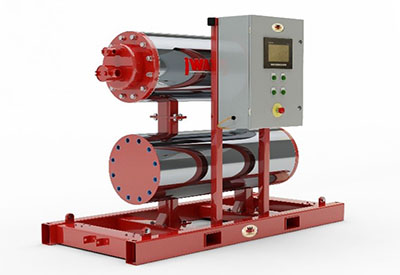
Companies that rely on flowing liquids such as oils, water or natural gas often rely on overly-complicated systems to keep everything functioning properly. These companies don’t worry about the systems being too complex until something goes wrong. Then the issue is a big deal, but it’s often too late for the system to be modified, or the company is committed to their current solution. To help set up that simple setup originally, your company should consider relying on inline circulation heaters for oils, natural gas, water or any other solution that has to be kept at a constant temperature. The heaters are flexible and can heat liquids up to 1500 degrees Fahrenheit or much less depending on heating needs.

How inline circulation heaters work

Inline circulation heaters are pretty simple in how they work. They have an inlet and an outlet that connects right up to your standard lines that the liquid is already flowing through. The liquid goes through the inlet, gets heated by the interior element, and then flows through the outlet back into the standard loop. These heaters typically come with insulation to help prevent heat loss, and some also come with filters to clean up the fluid flowing through and to protect the heat elements as well.

The heaters are designed with a thermostat so that you can adjust the final temperature of the fluid up or down until it’s exactly where you want it to be in the end.

Simple service and maintenance

When relying on an inline heater to warm liquids you won’t have to work nearly as hard to maintain the system and make sure that it functions properly. Often making a repair to the system is as simple as closing a valve and replacing a part on the heater or replacing the entire unit for a new one. There are less individual parts than there are in a tank heater, and the parts are typically more accessible as well.

Cut down on tank heat losses

If your application demands a nearly constant level of heat in oil, natural gas or water, you can rely on an inline circulation heater rather than a tank heater to achieve those temperatures more efficiently. When using a tank to keep constant temperatures, your system will suffer from more heat loss out the walls of the tank. When heating the system right in the line that needs the heat itself you’ll benefit from less heat loss overall and a more efficient system, not to mention that you’ll have one container less to maintain and replace when the time comes.

While it might not be worth the switch to move from a tank heater setup to an inline one if all your equipment is brand new, companies that are about to install new heaters, or a company that hasn’t yet put together a heated system should strongly consider using inline circulation heaters rather than tank-based systems. They are often more affordable and more efficient and they are certainly simpler and easier to maintain.


Ilan Toledano, is the President of Wattco. With over 20 years of experience in the electric heating industry, Ilan Toledano has been involved in sales and marketing, product development, and expansion of the industrial immersion heaters in the chemical and oil and gas industry for the past 15 years. Mr. Toledano has a B.Comm from Concordia University in Finance and Business Law; www.wattco.com

 

Related Articles


Latest Articles

  • The Role of Lighting in the AI-Powered Home

    The Role of Lighting in the AI-Powered Home

    January 14, 2026 Elizabeth Parks, President and CMO of Parks Associates, joins Derek Richardson, Founder and CEO of Deako, for a wide-ranging conversation on how lighting is becoming a core layer of the intelligent home. The discussion explores how Deako’s plug-and-play lighting approach is removing long-standing barriers to adoption by simplifying installation, reducing costs, and Read More…

  • What Canada’s Lighting Pulse Means for Contractors and Plant Buyers in 2026

    What Canada’s Lighting Pulse Means for Contractors and Plant Buyers in 2026

    January 14, 2025 By John Kerr From the ground, many contractors and plant teams are experiencing the same thing: jobs are there, but they are smaller, more price‑sensitive, and slower to release compared to past years. The Canadian Pulse of Lighting confirms that impression and offers some clear signals about how contractors and plant electrical Read More…

  • Guide to the Canadian Electrical Code, Part 1 – 26th Edition[i] – A Road Map: Section 54

    Guide to the Canadian Electrical Code, Part 1 – 26th Edition[i] – A Road Map: Section 54

    January 12, 2026 By Bill Burr The Code is a comprehensive document. Sometimes it can seem quite daunting to quickly find the information you need. This series of articles provides a guide to help users find their way through this critical document. This is not intended to replace the notes in Appendix B or the Read More…

  • Tom Penton & Magic Lite: Forty Years of Leadership in Canadian Lighting

    Tom Penton & Magic Lite: Forty Years of Leadership in Canadian Lighting

    January 12, 2026 By John Kerr Sales has always been at the core of Magic Lite’s story, because it was at the core of who its founder Tom Penton was. He genuinely loved sales, loved being independent, and consistently gravitated to roles where he could take personal responsibility for results and build his own customer Read More…


Changing Scene

  • Hammond Manufacturing Expands to Western Canada

    Hammond Manufacturing Expands to Western Canada

    January 13, 2026 Hammond Manufacturing have announced that they are opening a new distribution facility in the Southeast of Calgary, Alberta. The new facility includes over 50,000 sq ft of warehouse space. “This addition will better serve our customers in Western Canada and stock volume and larger products to ensure our distributors have an improve stock Read More…

  • ABB Chosen to Supply Technology for BC Ferries’ New Major Vessels

    ABB Chosen to Supply Technology for BC Ferries’ New Major Vessels

    January 12, 2026 ABB will supply a complete package of power, propulsion and control technology for four new double-ended passenger and car ferries operated by British Columbia Ferry Services (BC Ferries). One of the largest ferry operators in the world, BC Ferries provides year-round vehicle and passenger service on 25 routes to 47 terminals, carrying Read More…

  • Federal Government Invests in Four Ontario Steel Companies

    Federal Government Invests in Four Ontario Steel Companies

    January 12, 2026 Through targeted investments, the Government of Canada is committed to providing support to help businesses in all sectors, including steel and automotive, to respond, adapt and compete amid shifting market conditions. Evan Solomon, Minister of Artificial Intelligence and Digital Innovation and Minister responsible for the Federal Economic Development Agency for Southern Ontario Read More…

  • Craftsman V20 150W Power Inverter Recalled Due to Fire Hazard

    Craftsman V20 150W Power Inverter Recalled Due to Fire Hazard

    January 12, 2026 This recall involves the Craftsman V20 150W Power Inverter (Model number: CMCB1150B). The product has a rectangular prism shape with dimensions of 8.13 x 7.62 x 11.68 cm. It is red and black and weighs 320 grams. It has three charging ports for Type-C, Type-A, and AC connections. It contains an LED Read More…