Canadian Buildings Are Safer than Ever!
April 6 2016
Although it often goes unnoticed, emergency lighting has been safeguarding the public in buildings in Canada for several decades. The Canadian building code has been the national reference used to ensure that occupants are protected and have a safe and reliable means of evacuation out of Canadian buildings. Since the introduction of LED exit signs in the early 1990s, product development in this segment has been relatively static until recently.
Emergency lighting has seen major development over the last decade with significant changes to the 2010 building code, which introduced the green “running man” and photoluminescent technology. In addition, LED chip technology has dramatically changed the performance and life of remote heads and battery units, and the most recent proposed changes to CSA C22.2 141-15 Emergency Lighting Equipment are tightening performance characteristics of a variety of products offered to the emergency lighting electrical industry.
Let’s look at three recent changes in greater detail.
1. Changes to the NBC
In 2010 the National Building Code of Canada (NBC) published a new standard for emergency lighting specifically related to exit signs whereas exit signs now consist of a green pictogram and a white or lightly tinted graphical symbol meeting the colour specifications referred to in ISO 3864 and to the dimensions indicated in ISO 7010.

The 2010 NBC also has provisions for non-electrically lit exit signs that spell out the use of “running man” graphical symbols and stipulates the use of photoluminescents as well as the method in which these signs are tested and applied. Photoluminescence is simply rare earth metals that have a unique characteristic of glowing in the dark when the ambient light that is used to energize the sign extinguishes.
Photoluminescent exit signs must be ULC 572 compliant for 50, 75 foot and 100 foot visibility, and provide a green substitution for electrically powered signs. Another advantage of photoluminescence when properly used as outlined in the NBC, is that electrical wiring isn’t required and thus no direct electricity expense.

The changes to the NBC have been slowly implemented by Canadian provinces and territories, with Quebec being the last province to have adopted this new standard, which came into effect in June of 2015 with an 18-month transition period.
2. The use of LED chip technology in remotes and battery units.
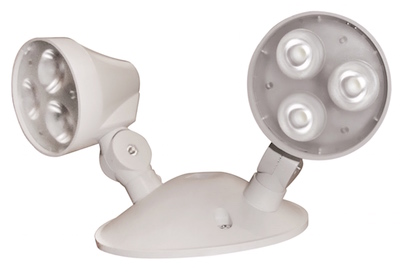
Battery units and remote heads are the most commonly used, stand-by unit equipment in buildings throughout Canada.
Battery unit:

Remote unit:

Their operation is quite simple. When an emergency lighting unit senses a power failure (Ac fail), the relay on the circuit board which contacts are normally open, close allowing the DC power (from battery) to flow through them and to the remote(s) and exits illuminating them for the prescribed duration identified in the National Building Code.
In this system, the lamp technology that has been the most commonly used in these applications has been incandescent or halogen with wattages ranging anywhere from 8watts quartz to as high as 70watts quartz. The standard lamp source and wattage commonly used has been the 9watt wedge base. Although the 9watts wedge is the standard lamp, the use of higher wattages and halogen MR16 type lamps are also commonly used when larger spacing’s, higher ceilings or greater light levels are required.
With the introduction of LED chip technologies we have seen a dramatic change in the type of lamp sources required to achieve the performance criteria mentioned above. As an example, 9 watt tungsten lamps offer anywhere from 80 to 110 lumens , have an average life of 100 hours and achieve a rule of thumb spacing ranging between 15 and 25 foot spacing’s. By using 3 watts LED remotes we are seeing up to 100 000 hours of life, performances of up to 377 lumens and spacings ranging from 44 to 77 feet. The use of LED lamps has also increased the duration of battery units from 1 hour to over 4 hours.
Example of a spacing comparison between 9 watt tungsten and 3 watt LED
Compare: where the building code requires an average of 1 foot candle and a minimum of 0.1 foot candle at the floor level along the path of egress on a 150’ x 9’ x 9’ corridor with an egress door at one end, a 150’ x 6’ path of egress, and an 8’ unit mounting height.
Incandescent Lamp: standard wedge-base 9W • PAR18-12V09W • Quantity: 15 • Average: 1.00:

3W LED Lamp: PAR18-6V3W LED • Quantity: 2 • Average: 1.00:

The benefits of LED lighting are clear:
- higher lumens resulting in increased spacings and therefore less remote units to install. In the above example, we have gone from 15x 9w double remotes to 2x 3w double remotes
- longer life resulting in a more reliable and safe system
- longer run times allowing the public more time to evacuate
- economy passed on to the building’s owner — smaller battery sizes and less copper wiring between remotes
3. Changes to CSA141 (-15)
CSA has recently proposed changes to the current standard for emergency lighting CSA C22. 141-15. In these proposed changes, particular attention needs to be given to auto diagnostics/auto test.
An auto test is a means for an emergency lighting system to automatically test itself in order to comply with the National Fire Code of Canada. It states that emergency lighting should be tested for one minute once a month and full discharge once a year and again 24 hours after the yearly discharge. The rationale behind this is that all batteries must be cycled regularly. If not, similarly to the battery in an automobile, they will most likely not work.
The discharge is to simulate an emergency situation whereby NFC law is required to do so. CSA states that all emergency packs should be completely charged within 24hrs. The second discharge 24hrs later is to ensure that the product is ready for another power failure.
NFC requirements are part of emergency standards and most manufacturers have some version of auto testing. CSA141-15 now has guidelines for auto test, which take into consideration that diagnostic systems should be tested to ensure they do the following:
- automatic testing every 30 days or less, verify/monitor load transfer, verify/monitor battery charge operation, and have a visual diagnostic with markings adjacent to the status indicators
- maintain normal intended operation regardless of the functional status of the auto test, meaning if during an auto test if the AC fails the battery unit will default to full emergency mode
This standard also has provisions for optional centralized computerized monitoring systems, enhanced visibility, and exit sign flashing options, and has defined testing criteria for temperature environments.
To recap, the green running man offers increased brightness and visibility when compared to traditional exit signs, and is understood by all nationalities. Building owners and managers now have the choice to add photoluminescence to signage, stairwell markings and supplemental directional signs, creating a redundant emergency system. The use of LED chip technology allows for increased light levels and over 100 000 hours of life, and increases battery back-up run times. And as prescribed by the NFC and now regulated by CSA141-15, if selected, the auto test/diagnostic option for battery units ensures that battery units will be in proper working order in the advent of a true emergency. We can safely say that Canadian buildings are truly safer than ever!
* CSA C22.2 141-15 Emergency Lighting Equipment applies to exit signs, unit equipment, emergency luminaires, and central power systems intended for connection to circuits with nominal voltages of 600 V and less and providing illumination in the event of a failure of the normal power supply for nonhazardous locations in accordance with the Rules of the Canadian Electrical Code, Part I.
Jeff Beare is Vice President of Marketing at Stanpro Lighting. He has over 21 years in the lighting industry, has spent the last 10 years at Stanpro Lighting in the capacity of Vice President of Marketing, and is heavily involved in product development. He sits on Electro-Federation Canada’s lighting committee and has chaired the Emergency Lighting subcommittee.