What Is the Optimum Combination to Heat a Home?
Aug 16, 2020
By David Letourneau
For residential buildings, there are many different types of electric heating solutions and even more products to choose from. Professionals can suggest different product combinations, so it’s important to understand the various benefits of each product to offer the best recommendations. The following article suggests a complete solution by utilizing the benefits of two ideal products: a combination of radiant floor heating on membrane and a heat pump. For both comfort and energy savings, these products offer an optimal solution.
The traditional single zone heat pump: a product designed for heating!
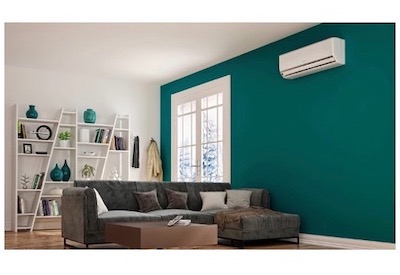
Wall-mounted heat pumps and air conditioning units have seen a lot of success over the last few years. We see a considerable increase in installations of these units in the months before summer (May, June, July). And with each passing year, thanks to development of the technologies used in modern heat pumps, their performance for both air conditioning and heating is getting better and better. Heat pumps work by transferring heat from indoors to outdoors in the summer, and from outdoors to indoors in the winter. It’s this principle of thermodynamics that significantly increases its efficiency compared to traditional baseboard heaters.
A high-quality heat pump (single zone or multizone) can act as a home’s primary heat source. The latest heat pump technologies help the compressor (the unit that pumps heat in each direction) take the maximum amount of energy from the outside air and redistribute it indoors using a powerful and ultra-quiet fan. The various product series from Ouellet Canada are all suitable for Quebec and Canadian climates. These units are mainly suggested for their heating performance even in cold climates, and they also offer added value for excellent air-conditioning efficiency in the summer season. Despite the low level of thermal energy in the outside air in winter, heat pumps offer excellent heating capacity at temperatures of -20, -25 and -30 degrees Celsius with certain models. In winter conditions they are more than twice as efficient as resistive heating. Depending on the model selected and outside temperature, a heat pump transfers between 1.5 and 4 times the electric energy consumed in the form of heat inside the home.
For example, for 1 watt of electricity consumed, a baseboard heater generates 1 watt of heat. For the same number of watts consumed, a heat pump will generate between 1.5 and 4 watts of heat. This superiority directly results in energy savings for the homeowner every winter. Some models have setback modes and the ability to connect to an app to further reduce energy consumption by lowering the temperature. At Ouellet, we regard these products as a heating solution for the future with the added benefit of cooling the home in the summer.
 The benefits of radiant floor heating
By heating the floor rather than the surrounding air, floor heating cables provide indirect, diffused heat that radiates from the floor up. This heat is absorbed by surrounding objects, and they in turn help to warm the entire room.
Radiation transmits thermal energy in the air through electromagnetic waves like light. These waves contain potential energy for as long as they remain unobstructed. Once they hit an obstacle, they release their energy in the form of heat through the material, in this case your floors, walls, furniture and even yourself! You therefore feel the direct radiant heat as well as a uniform heat, even when the surrounding air temperature is low.
This method of heating provides a more balanced and comfortable heat. The heat radiates from the floor, so that feet are the first part of the body to feel the heat. This creates a fast and comfortable warming effect and reduces costs due to a lower heating demand.
This kind of system is more expensive to install, but this is offset by its longevity and energy savings over the long term, as well as being a very comfortable source of heat. There are several ways of installing heating cables: on mat, strapping or membrane. All three methods are good, but installation on self-adhesive membrane offers additional benefits. You simply lay the uncoupling membrane directly over the subfloor, install the cable on the membrane and the job’s done! Installation of a heating cable for membrane can be completed in just one day, including installation of the floor covering. The self-adhesive membrane, cable and thermostat can be installed in a single visit by an electrician. A tiler can start laying tiles immediately after the electrician has finished.
An ideal combination for comfort
To sum up, for both new builds and renovations of existing homes, a combination of heat pumps and heating cables is a great option. Heat pumps are often only considered or installed for air conditioning, but they are actually one of the best heating products on the market in terms of energy savings. They are well suited to many different installations and the needs of customers. We recommend installing heat pumps in the fall and spring, because it’s never too early to enjoy energy savings.
David Letourneau is Product Manager for Ouellet Canada Inc.; david.letourneau@ouellet.com; www.ouellet.com