ESA Releases 2024 Ontario Electrical Safety Report

September 18, 2025
Electrical Fatalities in Ontario Drop on the Job, But Rise at Home
ESA’s newly released Ontario Electrical Safety Report finds electrical fatalities outside of work up 40%, even as workplace deaths decline
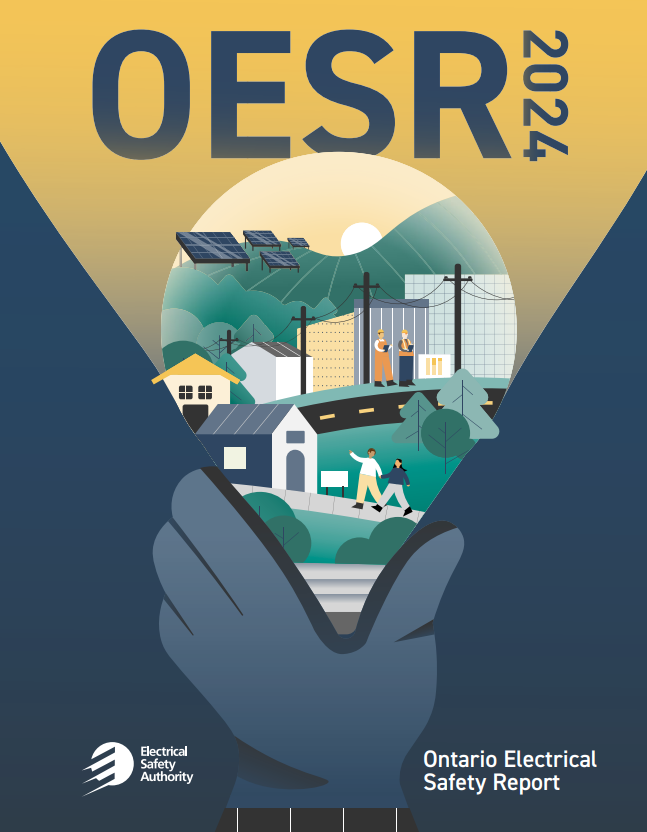
The Electrical Safety Authority (ESA) has released the 24th edition of its Ontario Electrical Safety Report (OESR), the only publication of its kind globally that provides a comprehensive review of electrical safety trends.
The new data reveals a sharp contrast: while workplace electrical fatalities have decreased by 59% over the past decade, electrical fatalities outside of work — including at home and in the broader community — have increased by 40%.
ESA’s Public Safety Officer, Patience Cathcart, said the findings show why vigilance has to extend well beyond job sites: “The OESR gives us a roadmap. It tells us where the risks are increasing and where progress is being made. Our commitment at ESA is to act on that knowledge — by educating the public, guiding industry and strengthening the systems that keep Ontarians safe from electrical harm.”
Key Findings from the 2024 OESR:
- 143 electrical-related fatalities occurred in Ontario between 2015-2024.
- Utility equipment was involved in nearly half (48%) of all electrical-related fatalities, with powerline contact remaining a leading cause.
- From 2014-2023, there were 9,672 emergency department visits for electrical injuries; 71% of patients were male, and most incidents occurred at home.
- Electrical fires resulting in loss have decreased by 10% when comparing 2019 and 2023; while cooking equipment is the leading cause of electrical fires, fires linked to electrical distribution equipment (such as panels and circuit breakers) have dropped 18% over the same period.
- Six electrical fatalities were reported in 2024, consistent with previous years and equal to roughly one fatality per million Ontarians.
The OESR is made possible through the contributions of ESA’s valued partners, including the Ontario Office of the Chief Coroner, the Ontario Ministry of Labour, Immigration, Training and Skills Development, the Office of the Fire Marshal, the Canadian Institute for Health Information, and the Workplace Safety and Insurance Board of Ontario, in addition to ESA’s own data sources.
For nearly a quarter of a century, the OESR has been a cornerstone for understanding electrical safety trends in Ontario. By bridging together data from across the sector, it provides the insights needed to focus safety efforts where the risk is greatest. As the electrical landscape moves through a period of transformational change, with demand projected to grow 75% by 2050, the OESR underscores ESA’s commitment to keeping safety at the centre of Ontario’s energy future.