What Is Dark Fibre?
April 25 2016
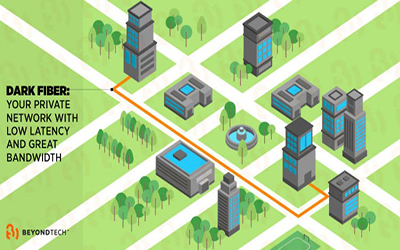
You surely have heard the term “dark fibre” and wondered what it is about. The term refers to optical fibre infrastructure that hasn’t been lit yet, meaning it has been installed but isn’t being used.
As we know, fibre optic cables are made of thin strands of glass or plastic through which data move as light pulses, caused by LED transmitters if the cable is multi-mode, or a much more sophisticated technology if it is single-mode. Dark fibre is called that because it isn’t active and there are no light pulses travelling through it.
Back in the 1990s, companies installed fibre optic infrastructure all over North America, especially in places with high-bandwidth demand, with the hope that demand would keep growing. But at the time it didn’t and the cost was many bankruptcies.
Nevertheless, the demand has grown since 2009 due to video streaming and smartphones — back in 2011, AT&T an 8,000% growth in mobile data demand — and the telecom industry started laying fibre optic networks again where they were needed as well as putting dark fibre use by leasing it to clients.
What it’s for
Nowadays, telecoms rent dark fibre to local broadband and content providers, healthcare institutions, government agencies and businesses that need to control their own network, so instead of leasing a service they lease an infrastructure that allows them to build their own network with their own equipment.
Leasing dark fibre offers a lot of benefits to the end user, for example avoiding spending time and capital in the construction, development and maintenance of their network. Also, in contrast with renting a bandwidth service, dark fibre provides low latency with very high throughput.
According to Arch Fiber Network, dark fibre gives clients the capacity to increase bandwidth as needed without paying any monthly additional cost and to upgrade the equipment at a time convenient them.
The report Dark Fibre Lease Considerations says dark fibre providers price it per strand per mile and in a set period. Usually, they give the client the Indefeasible Right of Use (IRU) for 20 years in a one-time payment, along with annual payments for operation and maintenance. Customers can also rent fibre for one, two or three years, making monthly payments with the option of leasing the infrastructure for another 20 years once the initial term is over.
Disadvantages
There are thousands of miles of dark fibre deployed across the country, and it still isn’t everywhere because it is only available where companies installed it or where they got permission to do it. Not all hospitals or businesses have access to dark fibre.
When dark fibre covers long distances it needs amplifiers, and those amplifiers need maintenance, which means spending more money. Furthermore, when long-haul dark fibre is exposed to accidental damage, it must be repaired by the company that leases the fibre, so reparations might take time.
Substituting
Wavelength services are an alternative where companies don’t want to lease an entire fibre optic infrastructure, because this allows them to buy a specific wavelength of an existing fibre from a service provider for their exclusive use.
This method is known as Wavelength Division Multiplexing (WDM), and it transmits several wavelengths over a fibre optic, which means data traffic is shared, but each wavelength has a specific laser with a specific colour. Thus, clients can get service from 1GBps up to 100GBps.
Renting dark fibre might be a solution to many businesses high-bandwidth demand, but being clear about its advantages and disadvantages is the best way assure a good decision is being taken.
Luis Cardenas is an economist and CFO of Beyondtech, Inc. This article first appeared as a blog. Source: Beyondtech, http://beyondtech.us/.


![Guide to the Canadian Electrical Code, Part 1[i], 26th Edition– A Road Map: Section 56](https://electricalindustry.ca/wp-content/uploads/2022/11/Guide-CE-Code-2-768x432.png)




![Guide to the Canadian Electrical Code, Part 1[i], 26th Edition– A Road Map: Section 56](https://electricalindustry.ca/wp-content/uploads/2022/11/Guide-CE-Code-2.png)