Considerations for EV Charging Installation and Site Preparation
December 15, 2025
By Blake Marchand
As part of our recent discussion with LEDVANCE EVSE Product Manager, Erich Bockley, he emphasized the importance of site preparation
Site preparation can be the most complicated part of the project, Bockley emphasized, a lot needs to be considered before the installation work begins. Many public charging applications will require trenches to get the power out to where it needs to go. Concrete and landscaping work could be part of the overall project. as well as establishing a strong internet signal.
With that in mind, this article provides a brief overview of some key considerations for EV charger installations, as well as a summary of code rules and bulletins relating to EV charging.
Adequate Power
EV chargers are a continuous load, the circuit must be rated at 125% of the EV charger’s load.
For a residential installation, for example, the panel needs to have the physical space for a new double-pole breaker, as well as the ampacity to meet the total load including the charger. An EV energy management system can be utilized to account for the additional load, without having to upgrade the panel.
Level 2 chargers require a fixed station and a dedicated 208-V or 240-V branch circuit.
Level 3 chargers are 480V, and more dedicated power infrastructure like a transformer, an upgraded panel, trenching and longer conduit runs from an electrical room to the charger location.
Level 3 chargers are suitable for gas stations and rest stops, as well as fleets, but require significantly more investment.
AWG
AWG is determined by the amperage of the charger and the distance between the panel and EV charger. A larger gauge may be required for longer distances to account for voltage drop.
Home EV chargers most commonly use 6 AWG.
Reliable Connection
An EV charging installation requires internet (ethernet or WiFi) or a 4G network to operate.
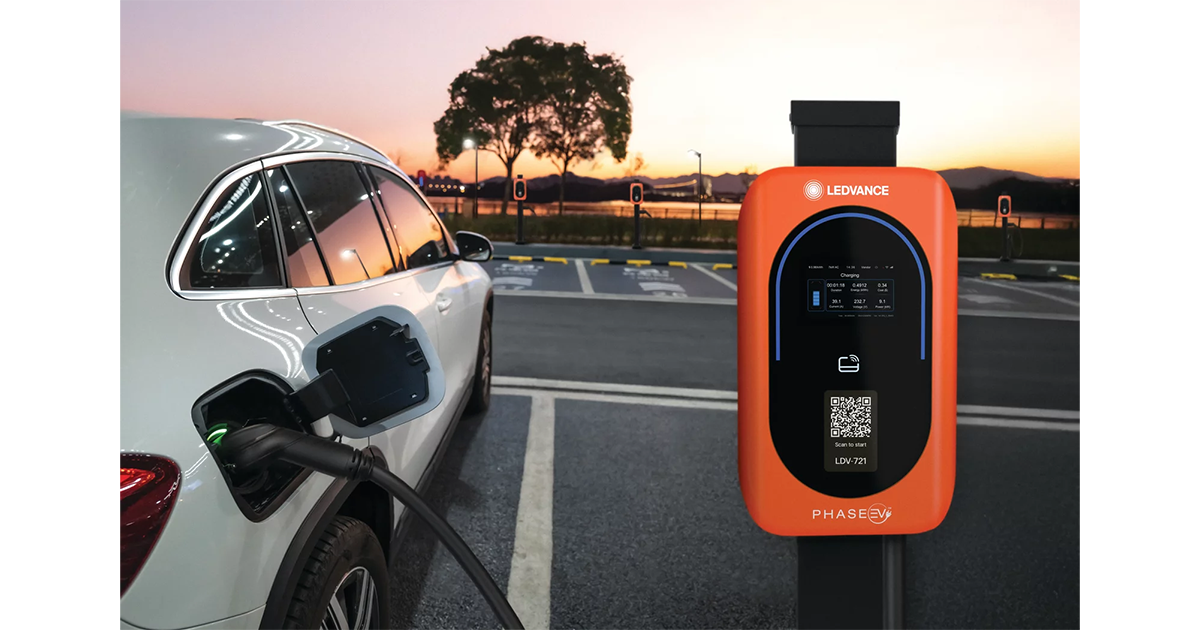
Bockley noted that LEDVANCE’s Phase EV Chargers have an ethernet port at the back, so the ethernet cable can be pulled with the rest of the wire to the charger.
“Before you even take a shovel to this, you need to be able to test using specialized 4G equipment (that’s widely available) to make sure there’s a strong 4G signal where you are going to install [the charger], and if there’s not, you have two choices. Either you install a 4G repeater to make sure you have a strong signal there, or you choose another location.”
Bockley noted that if you are relying solely on the 4G signal and you don’t have a strong and reliable 4G connection, then it will result in intermittent service, which is frustrating for EV drivers and charger operators.
Charge Point Operator, RFID
It is important for electrical contractors to work with the site owner to establish how the charger is going to be used and where it will be installed, to ensure reliability.
If the client wants a free use charger for employees or tenants, LEDVANCE’s chargers feature an RFID tap to identify the end-user. Otherwise, the charger needs to be paired with a charge point operator (CPO) to enable payment for public charging.
Bockley recommends that site owners that plan to generate revenue with the chargers get set up with the CPO ahead of the installation so that it can be ready to use once the contractor completes the installation.
“Once the site is prepared, the design of the EV Charger also has to be flexible. It should be able to accommodate the various possibilities that are demanded by the site,” Bockley noted, “the LEDVANCE Phase EV is available in multiple configurations to meet the requirements of the site.”
Mechanical Protection
EVSEs should be protected by a curb and, typically, installed at least 1m back from the front of the curb. If the charger is being used by trucks or larger vehicles, the charger may need more room to protect it from being damaged. Protected curb stops are suitable for underground locations.
For wall chargers, the bottom of the charger and electrical wiring should be at least 1m above grade, potentially higher for larger vehicles.
Also of note, if the installation is outside, the charger must be rated for outdoor use.
Summary of the Main Code Rules for EV charging:
Section 86 of the Canadian Electrical Code outlines the rules for EV charging system installation. It is important to be aware of local distinctions to the national code, some jurisdictions have bulletins or interpretations to clarify certain rules or aspects of an installation.
ESA’s Bulletin 86-1-7 clarifies installation of energy management systems and EV supply equipment (EVSE) demand factors, mechanical protection, and load sharing.
Technical Safety BC: Information Bulletin: Electric Vehicle Supply Equipment (EVSE) and Electric Vehicle Energy Management Systems (EVEMS)
This Alberta STANDATA Interpretation clarifies branch circuit conductor ampacities and overcurrent device settings for electric vehicle charging systems supplied with adjustable ampacity settings.
Rule 8-002: Calculated load – the load calculated in accordance with the rules in this section; Control of electric vehicle supply equipment loads – the process of connecting, disconnecting, increasing, or reducing electric power to electric vehicle supply equipment loads; and Electric Vehicle Energy Management System – a means of controlling electric vehicle supply equipment loads comprised of any of the following: a monitor(s), communications equipment, a controller(s), a timer(s) and other applicable device(s).
86-300 – Branch circuits: Electric vehicle charging equipment shall be supplied by a dedicated branch circuit that supplies no other loads except ventilation equipment intended for use with the EV charging equipment.
86-302 – Connected load: The total connected load of a branch circuit supplying electric vehicle charging equipment and the ventilation equipment permitted by 86-300 shall be considered continuous for the purposes of Rule 8-104.
86-304 – Disconnecting means: A separate disconnecting means shall be provided for each installation of charging equipment rated at 60 A or more or more than 150 volts-to ground. It shall be located within sight of and accessible to the charging station. It shall be capable of being locked in the open position.
14-106 and 36-208 – Protection devices: Protection devices are used to open an electrical circuit in the case of the adverse effects of overcurrents and short-circuits. Where possible, they shall be grouped together and easily accessible.
86-306 – Plugs for AC Level 1 charging: Single-phase 120-V outlets dedicated to slow charging must be CSA configuration 5-20R (20 A) even if the SAE J1772 standard allows a connection to a CSA 5-15R (15 A) outlet. If the outlet is installed outdoors, it must be protected with a Class A ground fault circuit interrupter (GFCI) or located at least 2.5 m above the ground. In cases where a GFCI is built into the charging cable, to prevent unwanted trips due to interaction between the two GFCIs, it is preferable to opt for a fixed installation.
Rule 86-404 reaffirms that electric vehicle supply equipment, located in hazardous locations or areas, conforms to the applicable requirements of Section 18 and 20.